4 Day Work Week Update
May 2, 2025
CONSUME CREATIVELY
This content is available in:
AUDIO
TEXT
Making Work Work for You
An update and lessons from our continuing four-day work week experiment.
When we started sharing about our four-day work week adventure, we quickly realized not everyone wanted a four-day week but EVERYONE wanted to figure out how to get more work done in less time. People all over are looking for ways to feel less overwhelmed, scoot out of work earlier, or get more done without losing their minds.
We’re all chasing a different version of success but the process that gets us there is much the same.
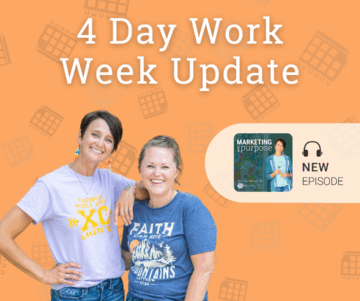
Even on our team the four-day work week rolls out differently for each of us. For some of our team members, it truly is a four-day work week with Friday completely off (woohoo, three-day weekends!). For others, like Stacy and I (hi, I’m Monica, nice to meet you!), it gives us the flexibility to handle life stuff without burning through vacation days.
Heck, just this week I was able to take my kiddos to doctor’s appointments during the workday because—naturally—the doctor doesn’t schedule on Fridays when I’d normally be off! And when Stacy came down with strep throat (yikes!), she could take a day to rest instead of playing superhero. Without this flexibility, she would have just tried to push through – slowing her recovery time and potentially producing less accurate work with the fog of strep holding her brain hostage. So, while we’ll both be working this Friday, we don’t consider that a fail. Because success to us means our weeks have the flexibility to be mom or even just rest when we need it.
Table of Contents
Your version of success might look totally different from ours.
Maybe you want to leave work early for your kid’s baseball games, or maybe you just want to accomplish more without feeling like your hair’s on fire. Whatever your goal, figuring out what success actually means to YOU is the crucial first step towards getting your ducks in a row for the new version of reality you’re after.
Our Journey to the Four-Day Work Week
Let me tell you, our path to a four-day work week was NOT a straight line! Here’s a cliff notes version of how we got there – if you need more backstory jump over to this post. It started back in 2019 when our team was huge (well, huge to us anyway, about 14-15 people) and we were trying to be marketing superheroes—offering everything under the sun and saying “yes” to every client request). We were BUSY, but not in a good way.
And like everyone else, after the dust settled on 2020, we realized we needed to shake things up dramatically. By 2021-2022, we were automation-obsessed, streamlining our services like nobody’s business, and drastically cutting down time spent herding cats (both employees and clients). Stacy and I started test-driving four-day work weeks during summers, and wow—suddenly we had actual mental bandwidth to properly serve our clients, support our team, and still make it to family dinner. That extra breathing room was a game-changer!
In May 2023, we made it official—four-day work week, here we come! The first six months? AMAZING. But then 2024 rolled around, and…as much as I hate to admit it, we started breaking our own rules. We’d meet someone we really liked and emotionally decide to take on projects outside our wheelhouse, thinking, “Oh, we’ll just put in a few hours on Friday.” Classic us! We also discovered that our rigid Friday schedule made zero sense with our rollercoaster workload.
Fast forward to now—we’ve gotten smarter about it.
This year we’re using a more flexible Friday approach, only working when things are genuinely swamped. Because we track and map out our workload sometimes even months ahead we can plan these “flexible Fridays” a month or two ahead so nobody gets surprised with a “Surprise! You’re working tomorrow!” text on Thursday night.
What’s been remarkable about this journey is that it’s never truly “done.” From managing our projects, to communicating with clients, we continue to refine our systems based on what works best for our current circumstances. We’ve learned that progress is ongoing, and that’s okay.
Tips for crafting the new version of work reality you’re after.
1.Know What Success Means to You
The most crucial step in transforming your work life is defining what success looks like to your business and team. When we were saying ‘yes’ to everything and continuously expanding, we were miserable despite growing revenue. We had to take a step back and determine what was enough.
For some businesses, success means higher revenue, regardless of the hours worked. For others, it might mean maintaining current revenue while creating more personal time. Ask yourself:
- How much is enough time/money?
- What do you want more time for?
- What’s your #1 goal? Fame? Money? Free time? Rock hard abs?
In the beginning we thought expanding the team would give us more time. But it wasn’t the simple fix it seemed. So, just recently, when my husband commented, “Monica, with the current MayeCreate workload, it sounds like you just need to hire another designer!” I had to explain that one designer means another account service person too. He said, “No,” and I said, “YES!” We’re at that tipping point where three-and-a-half designers already exceed our current account service capacity.
And don’t forget—Stacy and I would need to train these people, which is, unicorns aside, usually a year-long commitment. More people means more time in the office, more work to sell and LESS flexibility. Which is the OPPOSITE of our aforementioned version of success. And this compounding effect, my friend, is why growth isn’t always the answer. But we’re pretty creative so I have no doubt we’ll find another way. Which brings me to a very serious topic…roadblocks…
2.Recognize Potential Roadblocks
Even with the best intentions, certain roadblocks can prevent successful transformation:
Resistance to Change
If your team is super-glued to “the way you’ve always done it,” you’re in for a bumpy ride.
You can’t do it the way you’ve always done it and make it better at the same time. We’ve learned that having a solid “why” behind changes helps get everyone on board (I’m a little notorious for needing to know “why”—Stacy might say I have some millennial in me!). Which brings us back to the whole ‘understanding your version of success’ bit, right? Change for progress? Awesome! Random change just because? Not so much.
Undocumented Processes
You cannot—I repeat, CANNOT—automate a process that doesn’t exist.
If your processes live only in people’s brains, good luck with that automation project. You can’t automate a process without a roadmap. You’ll end up skipping steps and eat up all the time you’re trying to save troubleshooting, modifying, and patching automation holes. So make yourself a Google doc library, document everything, and link documents together so you can find the darn things. Your future self will thank you! And your future automations will too.
Unwarranted Tool Attachment
Those comfy old tools you’ve used forever might be secretly holding you back.
In 2010 we used Google Calendar and Google Sheets to manage EVERYTHING. I’m talking color-coded madness—printing out timelines and pinning them to bulletin boards! When we finally switched to resource management software, it was MAGIC. No more losing hours to moving each individual task in the project manually. Now if you move one task due date in the project management system, the next task in line moves as well-like magic! And don’t get me started on when Stacy “lost her marbles” over Google Chat during COVID. She went from “this is fine” to “I cannot DEAL with this chat software!” in record time. Switching to Slack with dedicated channels saved our sanity.
Other things that held us back initially were in-person meetings, paper note taking, and even installed software. All of those items caused us extra work, be it driving, typing up notes, or saving extra copies of documents to a shared drive..
It’s not always easy to let your old tools go, but if they are taking up extra time, hindering communication, or workflow, they may be holding you back. In the process of streamlining, you’ll have to make many decisions, one of which may be, ‘which do I want more, this notebook or to go to my kid’s soccer game?’ It’s your call.
3. Start Tracking
Before you can improve anything, you need data. OK, maybe you need initiative first. But tracking makes it a heck of a lot easier to decide WHAT to improve with a solid basis of why. We track everything from time to revenue and use that data as both a trigger and a gut check as we chase our version of success at MayeCreate.
Here’s a mind-blowing example from our own data:
Kara and Stacy kept this amazing spreadsheet tracking our leads, and when we finally crunched the numbers this last year—BOOM—85 or 86% of our leads (we’ll be flexible on the exact number!) came from personal contacts, current clients, or referrals. Not from all my blogging and marketing efforts! And I had invested a TON of energy into podcasts, emails and blogs from 2022-2024. So that data led to some tough decisions about whether I should keep churning out weekly blogs or shift to doing more billable client work. Data doesn’t lie, folks!
Without tracking, we would have kept pouring hours into stuff that wasn’t moving the needle. Hard data doesn’t just make decisions easier—it makes them stick when you start second-guessing yourself at 2 AM!
4 magic questions to jump start your four-day work week journey.
1.What are you doing that doesn’t yield results or revenue?
This question demands brutal honesty backed by cold, hard data. Are you spending hours on activities that don’t actually make you money? For us, tracking showed that all my blog-writing marathons weren’t bringing in the leads we thought. It was a total “well, that’s awkward” moment, but it freed me up to focus where it actually counts!
When you identify these activities, you have permission to stop doing them—though of course, you can’t just cancel client contracts overnight. Strategic planning for transition is essential.
2.What are you doing that you don’t like to do?
This question is more straightforward but equally important. If you’re spending time on tasks you dread, your energy and motivation suffer.
- If you dislike it AND it doesn’t yield results/revenue, stop doing it
- If you dislike it but it’s necessary (like Stacy reconciling QuickBooks monthly), consider whether it can be simplified or delegated
Some “necessary evils” like financial reconciliation have to happen—Stacy says future Stacy would really dislike it if current Stacy stopped doing this task, as it would create a mountainous problem come tax time. So it’s a keeper. But we have other tasks, like payroll, social media and online ads that over the years we’ve automated, outsourced or even eliminated.
3.What do you do that feels like it takes FOREVER?
These tasks are SCREAMING to be automated! Our estimating system is the perfect example. We started building this bad boy YEARS ago. But Stacy has transformed it from a bicycle to a rocket ship over the years. Now from the get-go, when she’s in a meeting with a client, she starts compiling the estimate, listing the pages, checking boxes for the needed functionality and auto-calculating a site estimate.
This beauty eliminated all those embarrassing math errors (Stacy would ask me: “Hey, did you know that this plus this doesn’t equal this?” And I’d be like, “Um, is it a purple number? Because I think in colors…”). Now, from that initial estimate tab, the sheet automatically calculates project task lists, billing and timing allocations to easily transfer into our project management system. It even creates all the documents we use to guide us throughout the website build process using an add on called Document Studio—pure digital magic!
When we started automating our podcast production, I discovered I could save 20 minutes per episode by using Airtable and Zapier to automate the project set up. One status change in AirTable and POOF!—folders are created in Google Drive, documents are drafted, posts are made on the MayeCreate website (oh yeah-that’s how this one started too) and links are inserted in AirTable and documents so I can find everything without having to hunt for it! And the best part? Everything’s consistent every time, which they definitely would NOT be if left to my “let’s try something different today” tendencies.
4.What tasks do you do on repeat that are extremely detailed?
Repetitive, detail-oriented tasks are goldmines for automation! These tasks not only eat time but are error magnets. Our website project templates ensure we never forget those mission-critical details that could spell disaster—like making sure a website can be indexed by Google. There is no faster way to tick off your client than forgetting to tell Google their site exists. Google owns like 92% of the market share!
Not all automation is complicated. Please, for the love of efficiency, stop with the email red rover for scheduling meetings! “I’m free Tuesday at 2…” “Oh, I have a conflict then…” “How about Wednesday at 11…” STOP THE MADNESS! Use the scheduling tools built into your email or Calendly to pick times that work. They click, and boom—meeting scheduled, link created, everyone’s calendar updated. Saving everyone time.
The Evolution Is Never Complete
Here’s the honest truth: this journey is NEVER finished. Automation and streamlining are like gardening—you’re never “done” with a garden! As Stacy puts it, “There’s always something new that you can be doing, or a new way you can do it. It’s ever-evolving.”
But please don’t let that stop you from starting! Even tiny improvements snowball over time. Can you imagine if we were still compiling every single estimate by hand? Stacy’s eyes get wide just thinking about it: “It would be a full-time job. It would be HORRIBLE!”
Instead, we’ve built our systems bit by bit over time. We didn’t magically leap to automation paradise overnight! We started with manual processes (so many handwritten notes—I had a whole color-coded system with specific ink colors), documented every painful step, refined what wasn’t working, and slowly introduced automation. Our client website review process was completely manual for a year before we started thinking, “Hmm, maybe parts of this could be automated…” Our document creation system started simply but has evolved into something Stacy accurately describes as “so stinking cool!”
Taking That First Step Forward
If your brain is exploding right now, take a deep breath! You don’t have to flip your entire business upside down overnight. Start small:
Make a List: Identify tasks that make you think “there HAS to be a better way!” I keep my list in Milanote so I can access it from both my phone and desktop. Those automation epiphanies always hit me while running or at 2 AM!
Choose One Thing: Pick the easiest thing on your list. Seriously, go for the low-hanging fruit first. Quick wins are motivating!
Document the Process: Write down exactly how this task happens now—every painful, time-sucking step. This becomes your “before” picture.
Research Alternatives: Check out our tools list below. Many solutions are WAY simpler and cheaper than you’d think!
Implement and Adjust: Try your solution, then tweak it based on real-world use. Perfect is the enemy of done—we’re looking for better, not perfect!
Your very first step might simply be determining what success looks like to you. Whether that’s a full-blown four-day work week, feeling less like your hair’s on fire, or just making it to your kid’s soccer game without checking email under the bleachers—it all starts with one step.
Just do one little thing. Those tiny improvements stack up faster than you think, and before you know it, you’ll be wondering how you ever lived without them!
Our Favorite Tools
Automation & Integration
Tools that reduce manual work and streamline processes:
- Zapier – Automates workflows between apps (especially those with integrations)
- Text Expander – Saves time by creating shortcuts for frequently used text
- Survey Monkey or Google Forms – Gathers customer or employee feedback efficiently
- Email Response Templates with TextExpander – Speeds up email creation with pre-written formats for consistency
- Chrome Extensions – Enhances browser efficiency with various tools
Website Tools
Tools that boost productivity by employing your website:
- Formidable Forms – Automate vendor sign-ups and approvals
- Stripe / PayPal – Allow vendors to pay directly online
- Calendly or Boomerang – Let vendors schedule load-in times or meetings with organizers
- Form to PDF – Automates converting form responses into PDFs
- The Events Calendar – Let visitors browse event times and locations online
Content Creation & Organization
Tools for writing, brainstorming, and designing:
- Claude AI & ChatGPT – Assists with writing, brainstorming, and generating content
- Canva – Creates graphics and marketing materials easily
- Milanote – Organizes ideas and creative projects visually
- Voice Typing – Speeds up content creation by converting speech to text. Otter can do this.
- Grammarly – A writing assistant that works across apps and browsers to improve grammar and clarity
Communication & Collaboration
Tools for staying connected and managing conversations:
- Google Workspace – Email, docs, meetings, and collaboration
- Otter – Transcribes meetings and notes automatically, great for in-person meetings where you can’t use Zoom
- Zoom – Virtual meetings, webinars, and video collaboration with AI meeting summaries
- Slack / Microsoft Teams – Real-time messaging, file sharing, and integrations
- Auto Email Forwarding – Automatically forward emails from your inbox to those who need them. We use Google.
Project & Task Management
Tools to keep work organized and on track:
- Project Management System – Keeps track of tasks, deadlines, and teamwork. Our team loves Active Collab.
- Airtable – Organizes data, projects, and workflows with a flexible database
- Google Sheets – A versatile tool for tracking tasks, timelines, and project data collaboratively
Marketing & Social Media
Tools to reach and engage your audience:
- Mailchimp / MailerLite – For sending email campaigns
- Loomly – Helps manage and schedule social media posts
Cross-Device
Tools that work seamlessly across devices:
- Cross-Platform Applications – Ensures tools work on both desktop and mobile for flexibility (Google Drive, Slack, Milanote, etc.)
- LastPass / 1Password – Secure password managers that sync across devices for easy login access
Have questions about any of these tools?
We’re happy to chat about how we use them! Email us at info@mayecreate.com.
Who Manifested This Madness?

This fabulous human, that's who.
Monica Maye Pitts
Monica is the creative force and founder of MayeCreate. She has a Bachelor of Science in Agriculture with an emphasis in Economics, Education and Plant Science from the University of Missouri. Monica possesses a rare combination of design savvy and technological know-how. Her clients know this quite well. Her passion for making friends and helping businesses grow gives her the skills she needs to make sure that each client, or friend, gets the attention and service he or she deserves.