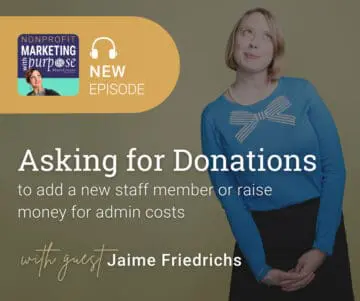
Asking for Donations to Add a New Staff Member or Raise Money for Admin Costs with Guest Jaime Friedrichs
September 2, 2022
CONSUME CREATIVELY
This content is available in:
AUDIO
TEXT
We love when our friend Jaime Friedrichs comes on the podcast and shares her fundraising wisdom with us! In this episode, she talks about when and how you can ask for donations for administrative costs or new hires. As a bonus, at the end of the episode, she walks us through a fundraising ask role play you can modify for your own needs.
Episode Highlights
Introduction of Jaime Friedrichs – 1:12
What’s the right mindset for asking for donations? – 3:52
How do you ask for donations for administrative costs? – 5:55
Should you include data and numbers in your ask? – 11:46
What three things must be in your ask – 15:30
Should you theme your giving campaigns? – 18:23
Do you need additional materials to support your ask? – 21:17
Are there benefits of fundraising for a specific thing over general needs? – 28:56
What can you do to build and maintain donor relationships? – 33:33
Fundraising ask example and role play – 35:08
Full Transcript
Jaime Friedrichs: My experience though with most nonprofits on a local level is they’re not spending a dollar that doesn’t need to be spent in order to keep their doors open and their mission going. And so every single thing that your nonprofit is paying for is really a part of your mission.
And so all you have to raise money for is your mission.
Monica Pitts: You’re on a mission and you just need more people to know about it. And whether you’re brand new to marketing or a seasoned pro. We are all looking for answers to make marketing decisions with purpose. I’m Monica Pitts, a techie crafty business owner, mom and aerial dancer who solves communication challenges through technology. This podcast is all about digging in and going digital. I’ll share my marketing know-how and business experience from almost 20 years of misadventures, I’ll be your backup dancer. So you can stop doubting and get moving towards marketing with purpose.
Hello again, and welcome back to Nonprofit Marketing with Purpose. My name is Monica Pitts, and I am your host today. And the lucky lady who gets to interview our guest, Jaime Friedrichs. Now, Jaime is no stranger to this podcast, I love to invite her back time and time again because I learned so much from her because she is a fundraiser at heart. And I, Jaime, I love the way that you think about fundraising and the way that you talk about it, it makes so much sense to me. And it just kind of all brings it back together. So I brought Jaime here today to talk about how to ask for donations to add a new staff member or raise money for administrative costs, because I have a lot of nonprofits ask me this question. And for some of you, I think it just feels kind of gross to ask for that. And so I want to Jaime’s take, and she’s going to coach us through this today. So Jaime, introduce yourself, and then I’ll start grilling you about questions.
Jaime Friedrichs: So yes, I am a fundraising coach, I work with small but mighty nonprofits generally who don’t have a full-time fundraiser on their team. So I work primarily directly with executive directors who are balancing all the other things that an executive director has to do, or with boards of directors, especially for all volunteer organizations where the board is really running the show. And they have a lot that they have to do. And they’re balancing fundraising, with all these other things. And so you want to make sure that the limited time you have for fundraising is going to be really effective. So that’s what I help those nonprofits do. I am. So I do that through my website, maximizing nonprofits, but also as the strategic partner for fundraising for new chapter coaching in Columbia, Missouri, and a lot of fun, because you’re right, I am a fundraiser at heart. I do love it. And I think that, especially our small, but mighty nonprofits are very worthy of philanthropic support. And so helping donors to see that worthiness and give them dollars is a lot of fun.
Monica: So before we answer this, how to ask for donations question, I would really just love to give our audience a small pep talk those people who are maybe, like, uncomfortable talking about money and asking for money, like what words of advice would you have to say to them about just especially coming into year-end giving season? Like, what can your mindset be in this time of asking?
Jaime: So I think one thing that’s helpful to think about is that everybody wants to help, I have the attitude that people are generally good-hearted, and they want to be a part of making a difference for things that they care about. And those of us who get to work in nonprofits or with nonprofits or be part of nonprofits, we get to do that every day all the time. But not everyone has that luxury, because their calling might be something else they might be in real estate or they might have a restaurant or you know, do have some other passion. That is where their professional time is spent. But they still want to do good in their community.
And I think that is what philanthropy is all about is inviting those folks to get to be a part of the really good work that you do. And think about how sad and unfulfilled you would be if you didn’t get to be a part of your mission. Well, you’re inviting someone else into it. that joy of whatever it is that your nonprofit happens to be working toward.
Monica: I love that attitude. That’s why I wanted you to say it. It just makes me feel happy. Because what some people look at as, like asking for money, or like begging for fundraising, you really look at it as an invitation to be part of a change or a movement, and of making what, like making a mission come to fruition. And and that has, that’s powerful.
So I’ve asked you this question before, a few years ago? How do you ask for donations to add a new staff member or raise money for administrative costs? And you had an amazing blanket answer for me. So I figured we could just start there. Like if somebody asks you this question, what do you say?
Jaime: The odds of me repeating myself two years ago are very slim. My first thought when you asked me this question this time is that for the nonprofits that I work with that are that tend to be locally based, and you know, the small but mighty variety, I don’t think there is anything such thing as admin costs. And so that’s not something you have to raise money for. And that’s not to say that you don’t have those things that tend to fall under admin costs that people term, like your insurance and your rent and utilities, and paying for the audit and your fundraising costs. And whatever the case may be.
My experience, though, with most nonprofits on a local level, is they’re not spending one dollar that doesn’t need to be spent, in order to keep their doors open, and their mission going. And so every single thing that your nonprofit is paying for, is really a part of your mission. And so all you have to raise money for is your mission, it’s, it’s okay to raise money to do the broad-based thing that you do, and to spend some of that money on insurance that will, you know, mitigate your risk of something happening and your nonprofit going under. So that may not be as true for big national organizations that, you know, tend to have more bloat. But really, all that stuff is absolutely necessary.
And I think from a donor perspective, when they really think about it, they don’t, they don’t truly dislike having their philanthropic dollars paid for those things, when those things are necessary.
So as long as you’re being efficient, and not wasting money, everything you have to raise is very worthwhile.
Monica: Including like to hire a new staff member, because like, if you can’t get your mission accomplished without having another body to help you, then it’s just necessary. Like, you can’t do it without them. And how is it bad to create another job? Like, that’s not bad? And when, when I had a nonprofit asked me this question a few years ago, I was like, well, it seems like, depending on upon the person, you could be pretty darn direct about what you’re doing. Like, because if it were me, and because I’m a business owner, and you said, Hey, Monica, we’re trying to further our mission, and in order to do so, my, you know, we need to have this person who’s going to do this job, I would be like, Yeah, that makes perfect sense. Of course, you do like, like, that makes sense to have some money, you know, but I don’t know if every person that you approach with that would feel the exact same way. But because I am so entrenched in that belief, I have a hard time thinking they wouldn’t be
Jaime: The argument some, and actually, not so much individual donors, but foundation funders might have is that well, how will you keep, how will you continue to pay this person after I make my donation and want to know some sort of sustainability? What you if you’ve done your calculation, right for expanding into a new position, having the person there is going to free up some other resources to long term have the revenue needed to fund the position going forward. And so as long as you have some sort of plan and strategy for that in place, which you should have that in place whether you’re adding a staff person whether you’re using a donors money, you know, whether you’re fundraising for the position or you have money for some others or from you know, some other place to add it, you want to know that you’re going to be able to keep paying them if you hire them. But as long as you do know that there’s no reason why donations couldn’t fund that to get it off the ground, you had asked if you would even mention hiring the new person at all. And we’re sort of talking about two different things in the same conversation.
You know, one is everyone’s getting ready or should be getting ready, I hope they’re trying to get ready for their year-end campaigns. And you mentioned that off the top. And so that’s one set of messaging, that’s, you know, for more of the mass appeal, and that I maybe wouldn’t complicate it by saying to specifically, how you are growing your first year, your program, your mission, your impact by adding another person, and focus more on what the additional things are, that your organization will accomplish through this other person, but really putting it in terms of the donors who are a part of your campaign, that they’re going to allow your organization to accomplish these new things, or serve more people, or whatever it is, is your rationale for growing.
And so I think you can talk more generally about growth.
But as you said, you know, if someone were to come to you one-on-one would have, it’s hard to imagine having an objection to that reason. And I think in a one-on-one scenario, I think it’s it’s very natural to be completely transparent with your prospective donor as to how this growth is going to occur. And so of course, you would tell them, that part of the reason for their donation would be to be able to grow your team, so you could do these additional things that need to be done in order to achieve your mission.
Monica: Now, if you are doing a like a mass appeal, do you find that it would work well, to include like data and numbers to like, through the I mean, like, but once again, talking about the two different things like, obviously, sitting down talking to somebody, you’re saying, do the very transparent approach, say what it is, it’s good, that’s going to be a good conversation in a way to build relationships and trust? But then in general, if you’re fundraising, you would did fundraising like, you know, in general, for your cause? As it is? Do you find that including, like data, and numbers can help that statement? Not for a person, but just in general for a campaign?
Jaime: Yes, definitely. And these are all numbers and calculations that you probably already want to have before you get to the point of, of raising money for a campaign, if you’ve made a decision that you want to grow in some way, you should have some basis for that decision on why you think that’s a good idea and what it’s going to accomplish. And I hope that at least part of that is based in some sort of data or calculation that you’ve done to determine, you know, additional beneficiaries served or, you know, expanded geographic reach or, or just greater effectiveness with your population, and what that will look like and what that will achieve and how it gets one step closer to, you know, the vision of the wonderful world that is being created through your nonprofit.
And so, yes, those numbers are really helpful to share in small bits in your mass appeal. And so choosing one or two, you know, really powerful reflective numbers that sort of tell the story. So if you’re talking about adding a physician, you might break it down by how many additional people will be served or how many additional activities will be done. But that’s not the whole story. And that’s not really quite enough for Mass Communications type of field or for a one-on-one conversation with a donor because those things are outputs. But and donors like to see outputs, actually, they like to know what the activities are that are going on in a nonprofit organization. But ideally, you should also have some data to show the outcome, and the difference is going to be made and you know, how that relates to your mission overall.
And then most importantly, you want to be able to show impact, and that I think is best done through a story rather than numbers.
So if the ultimate impact of your nonprofits work is kids being more successful in school because of that after school enrichment you provide, share a story that shows that a kid who was struggling and then the next semester started doing better, or if you’re an animal shelter, you share a heartwarming story about a pet being connected with a family and thriving in their new home. Or, you know, if you’re an advocacy organization it can be harder to get into those touchy-feely emotional stories. But if you find someone who is positively impacted by the change that you advocated for and got accomplished, that’s really powerful to include it in both places in your year end appeal. But then also having that story in your pocket when you’re talking to a donor, one on one, a larger donors gonna love to hear that story, too.
Monica: So the three things that you mentioned was that, okay, and I don’t remember the exact words, I only wrote, like you said, the first few. And I was like, Oh, this is, this is good advice. But I didn’t write the words down, and then my brain went on this bunny trail with you. So the last thing that you said was just share impact. But then also, there was the first set of metrics, like what were
Jaime: So your outputs, so the things you’re going to do.
Monica: And then there was something in the middle.
Jaime: Outcomes. So the things that you will measure achievement by so you know, your output is hours of tutoring, your outcome is the child’s grade.
And the impact is, you know, the child’s life changed.
Monica: That great example. So in your ask, those are three things that you could include in it, the outputs, the outcomes, and the impact. And to with that data, when you’re sharing data, I always like to read it and make sure that I can really, really consume it, I’m not a numbers person, if you put too many numbers in front of me, I literally have to draw a picture. So I can, like, get it, you know, I’m like one of those kids that was like, and here’s a pile of blocks, and then I divided into four stacks. And that’s how you divide by four. But there’s a lot of people like that in this world. So just make sure that when you’re sharing numbers, you break them down to a point where you, you absolutely make your point in the quickest way possible.
Jaime: And not too many of them and then stay with the story. One and only one story, if you start to share stuff, I mean, you might have 1000 success stories for how great your nonprofit is. But the with every story you add, it gets a little more complicated and a little more difficult to understand. And especially something like an email or a video or a social post, or any of those ways that we utilize for our year-end giving campaigns at you really want it to be shorter, sweeter and simpler.
Monica: Now, the things that we’re talking about right now seem like it would be perfect to include in like our year-end giving letter or like broken maybe even into pieces for an email or all together in an email. If you’re not doing year-end giving, let’s say that you’re going to do something in May, right? You just send a letter just like the one that we’re talking about right now. Or do you feel like because I’ve seen people like wrap it up in like a fancy theme, you know, like apples and apple trees or spring spring into something you don’t even like those creative little kitschy ideas. Do you find that those like fancy themes work? Or should we just be asking?
Jaime: So I would say that authenticity beats fancy, pretty much any day of the week, and you’re being very transparent and real with your donors, even on a large mass communications scale that should be effective.
But you’re right, the those cute things can be helpful for getting attention. I think it’s also helpful to be able to tell a donor why now. So with a year-end campaign, it’s obvious it’s giving season, everybody’s asking. So, you know, of course, this is the time that we’re coming to you for your support, when may can also be a great time to raise money. Same with March or April.
But having an answer to why are you asking me now that you can build into the campaign I think can be very helpful. And that could be centered around the thing you hope to achieve. But when we’re talking about something like the ongoing costs that nonprofits have to pay for, and that, you know, we should all be raising, you know, we shall be able to raise money to pay for those costs, like, you know, lights and insurance and our annual audit and those types of things. So, why would we be asking for gifts for our ongoing mission in May, tying it into some sort of timing, whether it’s something on your nonprofits calendar in particular, whether it’s, you know, a national awareness month of some type that has to do with your mission Have, or just a, you know, this is our emerging need and can point to it that way.
Monica: So I am hearing that we do not need to have a fancy tagline wrap up our fundraising stuff with, Yep, I’ll see be really empowering to a lot of people, because I can’t tell you how many folks are like, well, now I need to have a fill in the blank. And I’m like, but do you really need to have a fill-in-the-blank? I mean, you’ve got a mission, fill in the blanks with that, and it feels like that should be enough.
So, um, I people tell me Well, before they go on this big, you know, campaign, they’re going to have us build a book or a website for it or a really fancy thermometer or they want, like, you know, a brochure. Why do you feel about that, like, obviously, I like to make these things, we think it’s super, super fun. And I’m not telling you all that I’m not going to do that, because I’m totally going to do it. And I love, love, love, love making it for you, but do you need it?
Jaime: So, I always like to say that you only need two things raise money, which in fundraising jargon would be a case for support and prospects. But in normal people talk, it would be just a cause and people to ask.
And if you have something that you’re raising money for, and people that ask for money, in all likelihood, if it’s a good cause, and they are the right people, you should be able to raise the funds you need, you do need to know how to talk about your cause.
And I think that websites and brochures and all of the different pieces that you might have and build can be really helpful for laying all that out and communicating that to the people. But you don’t absolutely have to have them to raise money as long as you can explain the problem that you’re trying to solve and what you are doing about it through the donations you receive. And the reason that you’re confident that it’s actually going to work and make the impact that you want. That shouldn’t be enough. But a lot of times, that’s exactly what’s in a really good website, or a really good brochure, and, you know, nonprofit leaders, especially over work, the executive directors, and all volunteer boards are human, and it’s hard to get all that straight in your head.
And so I do think putting together those materials can be really useful, are getting all of that trade in your head and make the overall fundraising process just more effective generally. And at the same time, there’s also layers of getting more effective with connecting with prospects to, in trying to connect with people who are going to be more receptive to your cause, or who have some link to your organization who are interested in what you’re doing, you have the ability to make a gift, you know, those are all ingredients, that just people in general to ask, that’s one thing, but if you have people who are linked to your organization and interested in making the impact that you are and the ability to make a good size gift to you, well, then that’s even better.
So I think it’s kind of the same thing, as long as you have a cause that’s great. But if you have some really effective communications material, that’s even better, I wouldn’t let the lack of that hold you back from getting started.
Monica: I do like what you said, though, about how the process of making those materials, it just like clarifies what you’re doing. Because if I’m going to give a presentation, I sit down and I make my slides and as I’m like constructing the presentation, it all kind of comes together, slide by slide picture by picture, you know, and then I’m very confident in giving the presentation I don’t even really need the slides. It was but the act of making them prepared me for what I was going to do and and I think that’s really powerful. So it’s like a presentation aid.
I love that idea that the act of doing it prepares you and I also think that for some of those things you have to consider the size of your organization and what the expectation is going to be because like if you go into like so I’m going to use financial advisors which is really strange but if you like go into an Edward Jones office and you sit down and they’re like trying to explain to you how much you need to save for retirement and and they like take you through a worksheet that’s been pre made, and you’re like yeah, what’s seems like these people really have this together. And they should, because they’re Edward Jones. But if they would, if it was just kind of like this cobbled together, not very well articulated process, then you wouldn’t feel the same way. And you’d be like, well, am I paying like this money that work with this company, right. And so that’s the kind of take a little bit of that same approach with an organization, if you are a very structured or bigger organization, people might expect that you have a little leave behind something or another that they’re going to get.
Jaime: A nice thing is all about earning trust. And so having a brochure that lays out all of your facts can be helpful in that. However, it is not enough in and of itself. And it is not necessarily necessary.
But I think most I find often with nonprofit leaders, they know what their nonprofit does backwards and forwards, why it’s important, why it’s going to have the impact that they say it is, you know, what matters they are prepared in their head, they know the answer to every question. But when it comes time to spit it out of the mouth, to another person, it all of a sudden is that much more challenging.
Inside and I know it’s all there and and so part of the process of creating great fundraising materials is getting all of that great information that’s inside their head and into a format that makes it easy to share and to get inside the prospective donors head so that they understand as well as you do. And it doesn’t have to be super, pretty fancy. Well designed and just pretty streamlined and simple to just get it from here to there.
Monica: I can’t tell you how many like, website, like creative meetings will sit in, and we’ll be like, okay, so tell us what you do. And they’re like, okay. Ten minutes later, I’m like, hold on a second, I got you. Like, we’re good. I know what to do. And my goal is to make it so incredibly clear on your website, that when people ask you what you do, you can pull up your website and use it as your talking points. Let me read this one sentence on my homepage, it’ll tell you everything that you need to know.
But yeah, cuz it does you get stuck. I totally get it. I do. Um, that’s what my note cards are for. I have like these little note cards that I take with me to every, like networking event, and it’s like you review them and you’re like, what do you do? Well, I’m a, boutique web design company that works with nonprofits and construction people but like, like, you have to sometimes you gotta read that you can like, say it out loud, or words, you’re like, well, once upon a time, Mary Had a Little Lamb and its name was MayeCreate.
Okay, so, um, one question that I did have for you, Jaime is like, if they’re doing a fundraiser, and it is like the funds are going to a specific thing like, like, this is what you’re promoting it as, like, I’m raising money for this thing. How do you like either A, if you’re in taking general funds? How do you make sure that you can just use them for whatever you need them for? And then be like, are there like negatives to holding a fundraiser or or for raising funds for a specific thing? Because can you use them for something else? Like are you kind of putting yourself into a bad position there?
Jaime: Yeah, that’s a great question. So you can’t use them for something, have you raised money for a specific thing, you have to use the money for the thing that you raised it for. However, there, you is very helpful to be able to provide tangible examples of what funds use and I know, you know, we encourage this in CoMoGives what’s $100 gonna do for your organization, what is $50 up organization put it in tangible terms. But when we do that, we say things like $100, couldn’t buy XYZ not will buy or this organization is raising money solely for this purpose. And so as long as you make it clear that the tangible things that you are sharing with people so that they can get a mental image in their head of the kinds of things your nonprofit does. As long as you are saying this is an example. Then it should be clear to the donor but then you’re fine too.
Use the funds that you raise on your mission in general. And you can also be specific by instead of talking about specific things to buy, talk about specific things you’ll do or achieve or accomplish, you know, figuring out, you know, what your different activities cost your organization are, what it what one, you know, beneficiary, what it costs us, or one beneficiary at your organization, or what one type of advocacy work that is really important to your mission costs for the year and provide that as an example, rather than saying it will pay for this specific item, that can be a good way to go about doing that too, because then there are all sorts of expenses that go into getting that more impact outcome, the type number.
The other thing you can do, though, is sometimes is really effective to raise money for specific purchases, you know, the the large scale version of that as a capital campaign, where organizations raise, you know, hundreds of thousands, millions upon millions, and even, you know, for some higher education institutions, billions of dollars, to build stuff, or to buy stuff that, you know, sort of a larger specific purpose. But you can do those on a smaller scale. If it’s stuff, if you’re confident that this is stuff that you need to buy, there’s no reason not to person it out into specific fundraising opportunities that can be that might be raised through a specific year-end campaign or campaign during another time of year, or from a donor, it can be really great to pull from your budget items that are really important to your nonprofit, and ask if a donor wants to fund them specifically. And it’s not tying your hands because you need to buy those things anyway. And you’re doing exactly what you told the donor because you asked for those things.
Specifically, it’s just taking the extra step of rather than getting a pile of money and spending it however you want. Just having a little more specific budget in advance and then matching up specific donors interests with what your specific needs are,
Monica: I think, do that if you are going to raise money for a specific thing. Make sure that you use the money for that item, because you’ve built this relationship with your donor. And if you’re not using that money for that purpose, then you’re not continuing building that relationship, you’re gonna break trust. And I, I’ve seen it happen. And I like, even for myself, personally, I gave money for x. And then they’re like, well, we raised so much money that now we’re going to do it, do Y with it. And I’m like, well, those two things don’t feel really connected to me. And I have to take a step back. And I have to say, Well, why is still a very valuable thing. And I’m still okay with my money being used for that. But at first, I was like, oh, yeah, I don’t know how I feel right now about that. So just know that the way that you invest those funds after you receive them is also another thing that another way that you’re building trust with the people that support your organization, by following through. And doing that thing,
Jaime: I think one of the most important things to understand about a year-end campaign is a person’s first gift to your organization is almost never going to be their largest gift, if you treat them right and continue to build the relationship. So don’t just look at your year-end campaign as its own. I mean, the the money that you’ll raise is great. And you’ll put it to good use and wonderful, but it’s also a chance to get introduced to new donors who will have this particular experience of you. And you want to make that great impression. And then also to reinforce from your existing donors and, you know, deepen that relationship and build that trust even further.
Because I think the more donors give, the more frequently donors give and the more often they hear from you and better their understanding of how you operate while you operate and what you’re accomplishing. The more they’re just going to want to keep giving. Yeah, it’s kind of addictive. I mean, when when it’s acknowledged correctly, and you do you know, they say give it give it scientifically proven giving makes you happy. But the fun thing about being a fundraiser is by taking people’s money, you’re making them happy. By these they get the little jolt of joy that comes from you know, knowing you make a difference, but when You’re giving them that jolt really?
Well, they want to come back for more, because it’s a good feeling.
Monica: So, um, before we wrap up, I asked Jaime, before we came on air today, if she would do a role play with me, because we’re walking very big picture about and asking for donations, but sometimes you just need to hear it. Like you need to hear someone say the words. And you have given a couple of examples.
Jaime, as you’ve like, went through our conversation today. And I know that when I’m listening to things like this, and people are giving examples, like you were just doing, I want to be like, you know, wait, we wait. And I like, stop, and I rewind, and then I like write down verbatim what they say, because it just that made it so much more real to me when I hear it in action. So what do you think? Do we roleplay?
Jaime: Yes, do we have time to, for me to answer the last question that you had first? Because I think it will do it kind of set up the role play thing better.
So you had sent me a question about how do I work with nonprofits to help them feel comfortable asking for donations. And the first part of that is really dispelling some myths about fundraising. Because I think the reason people don’t feel comfortable asking for donations is they don’t know their donors and their prospective donors well enough.
And so our first step together is not going out and asking random people for donations by getting really curious about who are our donors, and you know, what makes them tick, and what do they care about? And what do they love about your cause already, and you know, what’s important to them. And so if you don’t feel comfortable asking, a lot of times, it means that you don’t have enough information. And so, you know, the place to start for that, I think, is just calling people up, not to ask them for a donation, but just to learn more about them, whether that’s, you know, getting together or chatting by phone or going on video. And, you know, as you start to get some of these answers as to why they’re interested in your organization, I think you’ll feel a lot better prepared to ask.
And so for the purposes of the roleplay, this would all be set up by me knowing you, and knowing your interest in my cause. And you know, knowing exactly what types of causes and donations really make your heart feel good and get your emotions going. You want to do want to share?
Monica: Okay, so, um, things that make me really happy. I, I love making art. I am always a sucker for an in-kind donation, because I love I love making something that I know is going to go further than the amount of money that you paid me would go. And so I, I love doing that, which is why we’re involved with CoMoGives. And we’ve mentioned that a couple of times, I feel like I should like just clarify to our listeners what that is. So CoMoGives is our community’s month-long year-end giving campaign. It’s all online. And it’s powered by the Community Foundation of Central Missouri. And we have about 150 of our local nonprofits that participate in it. And so my company is the marketing arm, and we build the website. And so that’s really fun. And, and a lot of that time is donated. And we feel like we’re giving our good back to like the universe, like we’re good at this thing.
So causes that I tend to gravitate towards, are like pretty much anything with kids or dogs. I’ve got dogs and kids. And so I get very attached to those two things. Was that the answer you were looking for?
Jaime: That’s very helpful. So well, we’ll presume that my cause has something to do with those things.
And so a key step is that when I called you to set up this visit, I tell you, that I want to share with you, you know, our upcoming program expansion and get your thoughts on it and see if it’s something that you’d like to be a part of supporting. So when we’re sitting down together now, you already know I’m probably an ask you for a gift. No one’s being surprised here. We don’t do, you know, shock fundraising.
So, okay, so let’s say I have an after school program and we’re putting together an eight week summer camp for while kids are out of school for middle schoolers, who have some sort of like difficult background hardship in their lives.
So probably something like it’s been thank you so much for taking the time to visit with me, I’m really excited to share with you that we are working toward expanding our summer day camp by adding an aerial dance instructor. We know this is a passion of yours, and that you’re also really enthusiastic about supporting the community in general. So I just wanted to see what you think about bringing this type of opportunity to middle schoolers.
Monica: Oh, my God, I was so excited. You did a good job, Jaime. Um, well, I think that there’s so many benefits that aerial can bring to middle schoolers, because it teaches you how to set a goal, how to work towards it, how to lift your own bodyweight. And there’s like, all these small wins. And I think it builds confidence. And I think too, you can create an environment where all of the kids really work towards cheering each other on. And so in that way, it’s another thing that can like help them especially in middle school age, because dang. Like, that’s a hard age, to like, feel good about themselves. Because it’s the big, it’s the big age, they need to feel good about themselves. So I think that sounds amazing. What a cool idea.
Jaime: Thank you, we’re really excited. So we found a professional instructor to partner with just spend a week teaching our kids aerial dance.
And so I’m just wondering if you have any questions about putting us on or any insights into the type of challenges or that we might experience with this.
Monica: You’re gonna have to get good rigging and mats. Or people are gonna get injuries. And that’s like, badness make sure you have the right insurance.
Jaime: We have definitely taken all those things into account. That’s why we are hiring a professional, who actually has experience working with this age, and not just aerial dance in general. And they’re bringing all of their own professional equipment. And we have talked to our insurer, of course, a big challenge is going to be cost. But we really think that the, you know, the overall confidence boost that this is going to give our kids is going to be well worth it. And you know, we’ve found in our surveys with kids, self esteem really is an issue at this age, they see themselves as clumsy or weak. And we think this skill set in particular is going to help them feel very graceful and strong. And just allow them the experience of succeeding at something that succeeding at something that seems really impossible, that when they do it, they’ll feel so good that we think that will translate into other things for the kids that have more success at school.
Of course, we need community support to be able to do this. And so is this something you could see yourself supporting?
Monica: Absolutely. I mean, like I have access to a network of aerialists, you know, in this community, and maybe it would be something that they would be willing to support to? I mean, because we all believe in it and know the good it does for us.
Jaime: Well, the program is going to cost us $10,000 to implement this summer for the for the week long experience for our group of kids. And because you’re a dancer yourself, and also very successful community leader, I wanted to ask if you might be willing to make a gift of $5,000 to cover half the cost of this program.
Monica: $5000. Well, in order to make a gift that big, I have to go to my CFO and ask her how she feels about that in our current financial situation. I could definitely do a gift of $1000 without her beating me down. But we can probably agree on something in the middle.
Jaime: Well, I hope that you’ll talk it over. I can follow up with you about it in a few days. I love your idea of involving more people from your particular community of aerialists in the project. We hadn’t really considered that. And if you’d be willing to help make those connections, it’d be amazing. And thanks so much for considering the gift. We’ll be in touch.
Monica: Yeah, maybe my other aerialists will be able to like fill in the gap where my CFO puts the kibosh on it.
Jaime, you’re good at this. It’s like you know that I spin around from the sky on piece of fabric.
Jaime: Well, that’s prospect research. That’s really good, important part of I mean, you do want to know what the interest and not in a stalker way which so, you already know that I knew this about you. So you don’t want to make your donors feel like you were stalking them that you did have something, you know, really crazy from their past. But again, you want to sort of know them. And the best way to know them is to talk to them.
So yes, what I encourage nonprofits to do is talk to their donors.
Monica: And I do think too, that like, if you were having trouble getting donations for a program, and you knew somebody who felt the good of it, you could, even if they can’t give you money, they could give you a quote, they could give you like endorsement, they, you know, there’s there are other things that they can contribute. And so even the conversation if it didn’t result in a $5,000 donation might result in the data or the endorsement that you need to get other people on board to be part of your mission.
So I always love talking to you. Thank you so much. Any like, final advice or like, pep talk that you need to give to these folks before they like go into year-end giving season? Go go go!
Jaime: I just start now.
And don’t be ashamed of asking, because you deserve it!
Monica: Yes. 100 percent. I agree with Jaime. And with that, I’m going to wrap it up. So thank you so much for your time today.
Once again, my name is Monica Pitts. And you’re listening to Nonprofit Marketing with Purpose. Now before I let you go, I just want to remind you about that little favor I asked you about in the beginning, will you please review this podcast wherever you’re listening? It will help us show up when people are looking for answers to the problems that this podcast will help them solve. So if you’re a fan and you haven’t reviewed the podcast, please leave me a review. That would be so awesome. I would love to hear your feedback. And if this was your first time, I mean double welcome and I hope you learned a thing or two. So leave a review so we can connect with even more awesome nonprofits just like you and help them on their journey to less stressful and more successful marketing. Thanks again for your time today. Now until next time, go for it and market with purpose.
Who Manifested This Madness?

This fabulous human, that's who.
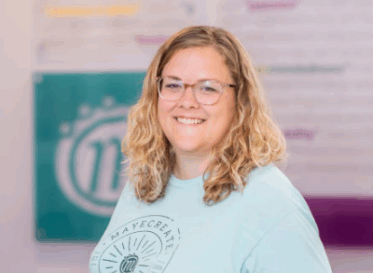
Monica Maye Pitts
Monica is the creative force and founder of MayeCreate. She has a Bachelor of Science in Agriculture with an emphasis in Economics, Education and Plant Science from the University of Missouri. Monica possesses a rare combination of design savvy and technological know-how. Her clients know this quite well. Her passion for making friends and helping businesses grow gives her the skills she needs to make sure that each client, or friend, gets the attention and service he or she deserves.