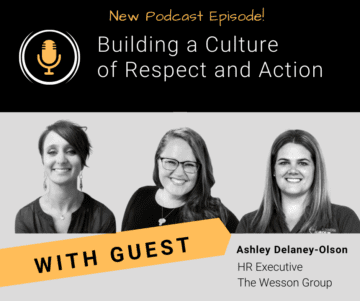
Building a Culture of Respect and Action with Ashley Delaney-Olson
July 8, 2022
CONSUME CREATIVELY
This content is available in:
AUDIO
TEXT
Today, we are going to focus on HR because I know that’s a challenge that we hear about so much in the industry. I have two awesome guests; our own Stacy Brockmeier – wearer of many hats, including HR – and Ashley Delaney-Olson, Director of Human Resources for the Wesson Group. We’re going to talk about what it takes to develop a people-centric company culture that fosters respect, action and loyalty in an era when job satisfaction is higher on prospective employee’s must-have list than ever before.
Podcast Summary Notes:
Monica: Ashley, why don’t you tell us about yourself?
Ashley: I am the Director of Human Resources for the Wesson group.
We are a heavy civil construction company based in New York State, we are in a really unique environment and market where we do alternative energy work. So we do the site work for renewable energy projects, wind and solar hopefully here soon. If supply chain becomes open we can get some solar panels in. But we are in a really cool market. Our company, our management here has touched 80% of the wind projects in New York state. So we’re really proud of that. We also have done some really unique projects, site work, we’ve done some marine work, but right now really focusing in renewable energy.
Monica: The way that we met Ashley, actually, is that we work on their website.
I could tell immediately through our initial conversations, hearing from Stacy and also working on your guys’s text in your website, that you are very driven by your core values and that you are a people-centric company. You really care about your employees. The culture that you have, that’s a strength. And and you have amazing pictures, by the way. So if you guys want to see like awesome construction photography, go check out their website. Ashley actually hires a photographer for each one of her projects. And so if you don’t hire photographer, you might follow Ashley, because she has awesome pictures. They’re really cool.
Ashley: Thank you, thank you shout out to Dennis Lee Photography.
We found an awesome guy who specializes in construction photography. And so we invest in that because he makes us look good. But yeah, so we started the company in 2013. The Western Group, interestingly enough, is named after my son Wesson. So that’s fun. But most of our senior leadership team had previously worked with our president now of the Wesson Group, Tim Delaney, who had started Delaney construction in 1982. We sold to a international engineering company in 2007. And he retired in 2012. So in 2013, thank the Lord, he was bored. And he said, Well, we’re going to do this again, and have some fun and see what we can build.
And so we were in a really unique place where we got to hand-pick our senior leadership. So Tim started the company with our Vice President Jeff Lantiegne, whom we had worked with for 10 years. I got to be employee number three. From there, we were able to hand-pick A players. That was so important in building our culture, because our leadership team — we all have those same values. We all want to be treated well and to treat others with that same respect. So it’s something that we were able to build into our company when we restarted it, but it’s also something that’s naturally occurring top-down. It’s not something that had to be changed about the company or built into it. It was all there from the beginning. So we’re really fortunate to have that.
Monica: As we were developing content for your website and listening to your members of leadership talk, we noticed you have an acronym that you use for your values.
Ashley: As we record, it is Construction Safety Week, the first week of May. And so one of the things that we do, which I hope others do in the industry, is extended toolbox talks — and that is really about keeping people safe.
Also about being positive, making sure you’re safe at work and at home. And we treat everybody to breakfast or lunch and all that good stuff. And that optimism is really important, right? Because safety is at our core, and it’s so important to us to make sure everybody goes home to their family. I think that goes to our integrity too. We’re going to invest in safety. It’s not something that we just say is top priority. We invest in it because we don’t want to have to make that phone call to somebody.
We want you to go home to your family, we want you to be safe.
We have a unique culture here where anybody can stop work at any point in time and ask a question, which ties into the curiosity. If you don’t fully understand a task, we want you to feel comfortable saying “Hey, I don’t know if if I understand this completely, and I want to be safe and I don’t want to hurt anybody else in the meantime” so we can stop work, get clarification and move forward. That culture is so important because, while production is important, you don’t get production if people are hurting themselves. So it really is important to us to make sure everybody feels safe at work.
We tie those values into everything day to day.
Our culture here is so unique to because it’s a family environment. Tim Delaney is my father, and I’m the director of HR, my brother works for the organization, my uncle, my much younger brother interns for us this year. But we have an Executive Vice President who is not family, and a Vice President of Engineering who is not family. So it’s hard to call it a family run company, but at the same time we have those values of family and that’s a huge piece of our culture. That is so important to us and ties in with the accountability and respect, because, as you know, you have that with a family anyways. It really makes a big difference here in the day to day to have all that.
Monica: Tell us about how you recruit. I’m even interested in the interview process — how do you find if they have the same core values as you?
Ashley: We’re really invested in our recruiting process, because we hire the right people.
Right now, we’re recruiting for project managers. And we can have people come through the door with amazing resumes, but if you walk in, it’s more of a team’s interview initially. If we have a first meeting and you’re arrogant, or you just don’t have that same — we call it our “special sauce”, we don’t even continue the process. In our interviews, we have specific questions we ask. A lot of it relates back to those core values. I can teach you a lot about construction. If you are the right person, and you’re curious and you’re accountable, and you’re driven, I can teach you what you need to know.
But you can’t teach people respect. You can’t teach people integrity, you can’t teach people optimism.
So when we interview people, we really make sure that we spend time finding out what’s important to them. How do they want to develop? Where do they see themselves in five to ten years? We look for people who want long term relationships. I’m not looking to bring someone in who in two or three years is going to turn around and look for another job. We want that long term relationship. We have a 96% retention rate amongst our management personnel, which I think is a great indicator of how well we do recruiting people who fit our values. You get to know people for who they are, not just what they know. So in that interview process, it’s really important to us to get to that piece of it.
Monica: Where are you finding your — I want to call them your “new friends?”
Ashley: They are all friends for sure. Which is why we mesh so well.
We stiI have the general recruiting process, but we have a really good referral process and program. I think that that’s a big driver too. People want to refer their friends because they like where they work. That’s huge. If you don’t have a good referral program, you need to look at why people aren’t referring people to your company. I’ve seen that in other with other people who I talked to. It’s, “Oh, well, you know, we give a $500 referral Bonus.” Well, that’s great, but people want a little bit more for bringing somebody in who’s going to be an A player to the table. So our program does pay very well, but also has a component where we donate to a 501 C three charity of your choice. So you’re getting a little cash in your pocket, you’re making a donation to a great organization, and you’re contributing to your organization by bringing an A plus player to the table. And so you have to also get creative about how you’re getting people in the door. But it’s important to me that people are referring people to us. And it’s not just our employees — we have subcontractors who will say, “Hey, we worked with the Wesson group and we worked for a subcontractor, but the way you treat your people is amazing” and they’ll apply. To us, that’s what’s important and that’s where we get good people, because they want to be part of our organization.
Monica: What job posting platform works best for you?
Ashley: I use LinkedIn, for the most part. We have a really good network between the senior leadership team and some of our younger staff.
We do get a decent amount of passive applicants from LinkedIn. We use our ATS system (applicant tracking system) that kind of cross-posts to a ton of websites. We used to use Indeed a lot more, but now you get the auto-applies and that just makes so much more work for me. It’s not worth it. We also have a really good internship program. We have three new hires starting next month who are currently graduating and all came from our our intern program. We have five current employees of the 40 that have come out of the intern program already and are growing in the company. So that’s a huge component for us, too, especially for the entry level folks. We don’t necessarily post those jobs externally, we pull out of those internal candidates from the intern program. That’s been really successful for us.
We do a student loan repayment plan. So for new hires, instead of maybe a cash sign on bonus, we will contribute money to their student loan repayment plan. With the amount of student loans kids have these days coming out of colleges, especially engineering schools, they love that. That’s been a really good tool for us to get people in the door.
Monica: What kind of tax credit do you get?
Ashley: Right now, you can pay I think it’s up to $5,250 a year before it becomes like a taxable fringe benefit.
So it’s tax free to us and to them. So if I have $4,000 in the budget to offer them a sign on bonus, I would much rather put it in that plan and give them the $4,000 towards student loans — as opposed to “Here’s $4,000, but by the way you have to pay tax on it at a higher rate because it’s supplemental income.” And we have to pay payroll taxes and whatever else on top of it, so now the actual value is higher but you’re seeing much less. Right now with everything going with COVID, I believe student loans are still deferred. So we had a handful of people say they would love to do that, because right now they’re being deferred. So it’s all principle.
So it’s been a huge win for us to be able to contribute to those folks. Our mission statement is to recruit, develop, motivate and retain the very best people. We have the people that are involved in the plan that currently work for us and this year we had a phenomenal year so we maxed out contributions to everybody enrolled in that plan. We had two people in tears; they couldn’t believe we contributed $5,000 to their plan. Talk about retention. I mean, come on, does it get any better than that? And it’s five grand a person!
Employee burnout is such a big topic right now. And it’s not just that people are working so many hours, right? Burnout can come from home, too.
So you’re making a decent wage, but you have a mortgage, and you have student loan payments, and you have child care payments, which we all know are insane. So if you can help alleviate one of those larger payments — and, as you know, student loan payments tend to be higher -that just helps because they’re not working just to pay bills. Now they’re working and saving for a vacation. That helps with employee burnout and helps make them more positive at work too, because as an employer you’re helping with that big payment and bringing it down.
Monica: One of the things we’re really interested in is learning about your HR software. There’s a lot of people who are transitioning into using one who haven’t used one before or are maybe ticked off at their current one and thinking about a new one.
Ashley: We actually switched this year to Arcoro HR, which acquired BirdDog HR.
So far, so good. We made the decision to switch for a couple reasons. One of the biggest was that they have a really good learning management system that’s part of their package. As we talked about already, that continuous learning is a big component for us. We have what we call the TWG Academy. It’s really a development plan for our operations staff. We’re able to put our coursework in there, we’re able to put safety trainings and all of our onboarding training in there. People can look at it at the plans and see, “Okay, I have to accomplish a, b, c, d, in the next year.” It links your goals to the training and your performance evaluations are in there. We do 90 Day evaluations and that’s also in there.
For us, it was important to have the documentation in one place. As a construction company, we have multiple projects and to support the projects people may move right from one to another and work for a new project manager. So the project manager can now go into the system and look at the performance reviews, look at their goals and see how to support them. When that information was on paper, it sat in a file in the office, which doesn’t do anybody any good. Now it’s electronic; you can review it as the employee, your managers can see it.
It’s got a really unique function where it shows you how you compare core competencies to people on your project and in the organization as a whole. We use a grading scale of one to five. Maybe you’ve got threes across the board and you feel you’re doing all right — but then you look and see everybody else has 3.5 or 4 and maybe then you realize you have some things to improve. Or maybe you were rated really high, but didn’t feel valued, or just didn’t know how you were doing. Now you can compare yourself against all employees in the company and discover that you’re doing really well. That’s a motivator for people. It’s about making sure that the information is available and that people have it. That was really a big piece of why we switched.
Monica: Is Arcoro focused specifically toward construction companies?
Ashley: I don’t honestly know, but one of the other driving forces behind our choosing them was that Arcoro speaks to our accounting system.
For instance, our onboarding is on Arcoro now. When people finish it, I just push a button and it’ll push to create a new hire in our system, which eliminates all the data entry. And I know that they do talk to a lot of construction accounting systems, so I would think they probably have a construction background, but I don’t know. They also tie to QuickSafety.com. That’s really important because I can bring in all of QuickSafety’s trainings. As I think about it, they link with everybody. They work with a lot of other companies across industries.
We did use Bamboo for a few years and they were a fine system. We just wanted to expand and have more, which really was the learning management, the onboarding, and pushing to the new hire platform in our accounting system. As a one-man HR band over here, I was all about it.
Stacy: We’re currently in the process of incorporating Arcoro into your website.
So we’ll have the application online, which I think is super important, because we all are hiring laborers and people who are going to be in the field may want to apply on their phone. So I think that it’s really helpful there.
Are there any other features that are going to be incorporated into your website that you’re really excited about?
Ashley: There are things you’re incorporating into our website that are not HR related, but that we’re excited about.
Incorporating the maps of our projects is super cool. We’ve done a lot of statistic-based things that you’re gonna have rolling numbers and that information is so important for both potential employees and potential owners of projects. They want to see how great our safety program is, and our ratings and we have a great safety record, so that’s excellent.
We want to promote that and you guys are helping us do that in such a unique way. I’m super excited. We’re so close to launching this website. It’s one of those things that I’m nerding out about.
Monica: With your academy training content that is being incorporated into your new website, is that something you guys put together as a team, or do you delegate that?
Ashley: Our senior leadership team here all ask what trainings we want our team to have and what do we need to be successful.
And we use a lot of our relationships with AGC. AGC in our state chapter in New York has some great programming. So we’re part of what’s called FBI, but it’s the Family Business Institute. People always look at me weird and I’m like, “Oh, wait, no, hold on — It’s not that FBI.” But they have some great programs and development programs that we send our staff to. CFMA, Construction Financial Management Association has courses and we will bring a lot of that into our academy.
So it’s not necessarily creating all of our own programming. It’s just finding the right courses that benefit our people the most and integrating that into it.
A couple of years ago, our construction manager and I started what we call the TWG Safety Academy. We do an hour a week of Safety Academy and the first year I presented topics each week, and had people give their background and experience and then bring in some of their lessons learned for the topics. By the end people got real sick of me, so this past year I said “enough of Ashley” and we brought in a lot of really unique speakers. We had people from insurance companies come in, we had some subcontractors come in. We do a lot of electrical on wind farms and solar, so we had an electrical sub speak to us on electrical safety. We had Crane Safety and things like that, but we had a guest speaker in each session, which really caught people’s attention — when it comes to safety, obviously that’s the most important thing. You want people to take something out of each lesson. So yeah, we ended up with ‘enough of me and my voice’ and delegated to other people.
Monica: Any final piece of advice that you would like to offer people to generate the same type of culture and learning environment that you guys have in your company?
Ashley: Honestly, just “live it.” You can put words on a wall or on a website, and they can be the best, biggest buzzwords in the world. But if you don’t live those every day, and your people don’t feel it, then it’s not going to work.
That’s something people say here all the time. We hire them, and they’re like, “Oh, we love that your values were CARDIO.” Then six months later, they’ll be like, “You guys really live this every day, this is such a huge piece of what you are.” To me, if you don’t live those words, especially respect, then people aren’t going to buy into it and that culture doesn’t happen. You have to live those values and truly believe them in order for it to work.
Monica: Tell everybody where they can learn more about the Wesson group.
Ashley: Our website is twg.us.com.
Hopefully, the new one will get launched soon. We’re super excited about it. And we’re also on Facebook in the Wesson Group. And hopefully soon we’ll be on Instagram. This one-man band is a little behind the eight ball. But we’re also on LinkedIn, the Wesson Group LLC. Feel free to always give me a call or shoot me emails — I love getting questions from people outside of our organization. It makes me happy when people ask me for advice and things. I’m also on LinkedIn, and on Instagram, and I do share a lot of Wesson group things, all the good stuff.
Who Manifested This Madness?

This fabulous human, that's who.
Monica Maye Pitts
Monica is the creative force and founder of MayeCreate. She has a Bachelor of Science in Agriculture with an emphasis in Economics, Education and Plant Science from the University of Missouri. Monica possesses a rare combination of design savvy and technological know-how. Her clients know this quite well. Her passion for making friends and helping businesses grow gives her the skills she needs to make sure that each client, or friend, gets the attention and service he or she deserves.