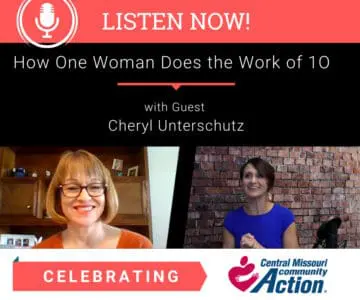
How One Woman Does the Work of 10 – Celebrating Central Missouri Community Action
February 11, 2022
CONSUME CREATIVELY
This content is available in:
AUDIO
TEXT
I’m super excited to have Cheryl Unterschutz on this podcast. Cheryl is the public relations manager and the marketing manager for Central Missouri Community Action. Between those two roles, she wears numerous hats and handles more responsibilities for her organization than I even dare to think about – yet she does them all well. This team of one is here to tell us all about her marketing journey and how she put together her marketing plan. I know that you guys are going to learn a lot from her experience in the trenches as an everyday marketer for her nonprofit organization.
Podcast Summary Notes:
Monica: Tell us about your role with Central Missouri Community Action
Cheryll: My full time position is the public relations manager for Central Missouri Community Action.
We go by the acronym CMCA and we’re that agency that is on Providence road if folks are in Colombia, but we are a member of the National Community Action Partnership. So community action is a organization or mandate through a law that was passed in 1965. Our goal is to help families who are living at or below poverty level move out of poverty, become financially stable, develop the skills and resources they need to be successful and self sustaining.
In my role as public relations manager, I do public relations, which means when the newspaper calls I connect the reporter to the right program person to talk about the program. I help find families for reporters to interview. I also do some story gathering and writing around family stories.
I’m also the marketer. I’m the only one, but I jokingly call my office “the marketing team”. Our organization does do a lot of team projects. In that role, I do all of the strategy for marketing. There are about 200 employees at CMCA and there’s a leadership team–a lot of the work that I do is with the leadership team to make sure it’s reflective of our agency. I’m kind of the main person who deals with the graphic design and I manage the website and social media.
I make the plan and I carry it out. I make sure I get all the pieces that I need, create products that will market and educate folks about CMCA. Of course fundraising is another part of my job. So I’m the primary and only fundraiser. In that role I deal with both grants and individual and corporate fundraising events. If we win, we have those again, and really just work to try to raise unrestricted money for the organization so that we can use that to support families on their journey towards self sufficiency. A lot of the money that comes in through CMCA is restricted since it’s federal or state money. But not everything falls into the categories of restricted money–then you have a family working hard to become self sufficient and then suddenly their car breaks down and dad can’t get to work. I mean, that can throw a wrench into the whole plan of getting a job, getting enough income to become self sufficient. If he can’t get to work, he loses the job, suddenly that whole goal of self sufficiency becomes difficult. So those unrestricted funds become our way of helping keep them on track toward their goal. On the side, in my spare time, I also help with Girls on the Run here in Colombia, or in mid Missouri. I made sure the program stays active. I work with the board to make sure the organization stays on track with marketing, fundraising, and all that fun stuff too. So I stay plenty busy.
Monica: I’d say you are a busy human being. I feel like you’re very in touch with your customers’ universe. That’s something that all marketers should absolutely aspire to; to have a deep connection with the people that they serve because that is where it all comes from, right?
Cheryll: It is and I do really appreciate that you recognize that.
Because I do deeply care about the client–we call them members, most folks will call them clients. But I do care about the members and I have the opportunity in my role to meet them frequently. Whether it’s just because I do answer the door a lot, my office happens to be close to our our administrative office front door, and it’s been locked over the past year. So I’ve the doorbell rings. And if the other person that normally answers isn’t there, I’m the one that does and I get a chance to chat with these folks. I also get to meet them when I do stories. I just really love people, and I love their stories. I care about where they’re at and where they’re moving forward. And I’m a natural cheerleader, so I really love to cheer people on for success.
Monica: Tell me about where you were before you had a marketing plan? What were the challenges that you were trying to solve?
Cheryll: I’ve been with Central Missouri Community Action for two years. And I will tell you, the first year at the organization is so diverse..
It’s one of those organizations where you can’t just say, well, we help animals or we help kids. Our programs are diverse and widespread. We serve eight counties and we have different types of audiences in those eight counties–a variety of audiences of potential members or clients as well as community partners that we work with and donors. So there was just a lot of stuff to try to figure out. How am I going to share to the lay person that comes along? What is CMCA? I can say that we work to help move people out of poverty. But what does that mean? We’ve got more than 15 programs and within those programs, there are multiple services and other programs that are underneath.
That was what brought me to the your nonprofit marketing workshop because I was really feeling overwhelmed by that.
I had been slowly getting more and more familiar with everything and understanding kind of how everything links together. But it still wasn’t fully clear to me how I was going to convey this to our community and all our different audiences. It was during your workshop, really during our personal consultation, which is a cool part of that workshop (I mean, how often do you get to have a personal consultation with the person who provides the workshop, usually, it’s the workshop, and then you’re done and you have to figure it out on your own). When I got to meet with you personally, that’s when it all became super clear to me what we needed to do. You helped me see that we needed to create the steps to self sufficiency.
Our goal as a agency is to help the family or individual who comes in struggling financially, living at or below poverty level, to get from there to being self-sufficient. So how did they get from that point A to point B? When you identified that for me, it just opened the door. I get chills thinking about it, because it’s like, “Oh, of course.” You get mired down when you’re in the middle of it day to day and you’re hearing about this program and that program. How do I make everybody understand that these programs connect, and there’s a purpose for all of them? And sometimes you need them all. And sometimes you only need a couple but that is what helps.
So with your guidance, I created a graphic. I’m a graphic designer by trade, so visual communication is really important to me. I created a graphic that really simplified the steps that we take when an individual or family comes to our agency. It’s called the “Steps to self sufficiency” and I shared it with our team leadership are our agency leadership. They were like, “Wow, this is what we were looking for.” That has become sort of the base of my marketing. Now my marketing plan / fundraising plan has really become the center, because what I can do now with that simple plan in mindis really talk about our programs and relate them back to how they play into those simple steps. I can talk to donors about how their gifts relate back to those steps.
My hope had been that somebody could help me kind of take all this massive information, and somehow make it palatable and understandable for our employees and our external audiences. Because even within our own agency, it’s hard to know how other internal departments impact your program, or how your program impacts theirs. So once we started talking about this concept of the steps, it really opened my mind to how I could help our employees better understand each other’s roles in in this journey. It also helped me share that information to potential clients and the other audiences that we want to inform about our agency. Because we do a lot of amazing work and it’s really hard to explain that to the community. So that’s why I came to the workshop, and it really has helped a lot.
Monica: What does a marketing plan look like for you? In other words, what are the components and parts of it – how granular do you make yours?
Cheryll: Well, personally, just in the the organizations I’ve been with, it’s always been on me just to create a plan of some type.
And so I’ve always just approached it as a very general big overview, and not a day to day or week to week or month to month plan. Well, that’s nice; it gives you a kind of a broad brushstroke of what you want to do for the year. But then what I found was, I was constantly forgetting what the specifics were, or I would push it off. There was always something else coming up. So at broad brushstroke, what it lacked was accountability. For me, it was really hard to say, “Yeah, I have these goals to meet and I’m meeting them.” And at CMCA, we’re very data driven so I know that I need to have goals that I can show I have met. And so the more hands-on “Here’s the general overview. And now we’re gonna move into here’s the monthly overview. And now we’ll move into here’s the daily…” has really been helpful for me, because I still have my overview for the year, but I’m also getting that more granular stuff that you’ve talked about, which I needed just to keep me on track.
We have so many things happening and stuff changes–but what I like about the plan you helped me develop is that, while it has some details that are pretty granular, it’s also flexible.
It’s not like, “Oh, my goodness, I didn’t do it on Wednesday, now, I can never do it at all.” I can adapt and adjust if I need to. For example, I got my COVID vaccine Tuesday, my second one. So, you know, Wednesday was pretty much out. You can’t always predict how some days aren’t gonna work for you, but that doesn’t mean I shouldn’t do what I plan to do Wednesday on another day. So it gives me flexibility, but it also gives me that accountability that I need. It helps me to have goals I work toward, can measure and share out to my leadership and to our board.
Monica: I feel like when I plan further out into the future, it allows me to focus on what needs to be done without the stress. Because I can see that it’s due on some future day, I find that I’m working ahead more than I would ever be if I were just shooting from the hip.
Cheryll: Oh, yeah, it definitely takes a lot of that pressure off.
The clarity is what takes that pressure off because, going back to where I was before we started–before we figured out that steps to self sufficiency–I was just constantly wondering if I was really doing what I needed to be doing. I just didn’t have the self confidence that I was really achieving what I wanted to achieve, what the agency needed me to achieve. I really feel more confident and empowered now because I have a much clearer picture. I have the steps set up to help me reach that those goals without me having figured them out every every day. That way, if something comes up I’m not as stressed about it.
Monica: Despite all the distractions I know you’ve dealt with in your roles, how did you manage to stick with your plan? Do you have any advice that you would give the people who are having difficulty getting that plan done?
Cheryll: Well, let’s see, the first thing was I didn’t want to let you down, because you’re excited, you truly care.
When I see someone offering something like this, and you’re doing it for the right reasons, and you care about people, and you really do want to see us succeed, you’re not in this just to sell a ticket to the event–To me that that means a lot. You dedicated yourself and you were committed, so I felt like I owed that back. But also, I knew that our organization needed this, I needed this. I want to do an excellent job, I want to really be able to share with our community the amazing work that we do at CMCA. To raise the money that we need to support the families in the way they need to be supported. I knew I needed to do this to make that happen.
So that’s what really drove me to continue forward. But I have been one of those people in the past where I’ve started a plan for fundraising or marketing and, yeah, I’ve kind of half heartedly done it. And then I never look at it again, or I don’t finish it. What I know from that is, “what’s the point?” I’ve wasted my time, because I didn’t really put what I did into practice. It was nothing more than an exercise. You’re really not going to get anything out of it unless you follow through and implement it and learn from it and grow from it. I know I’m going to make mistakes, but I’m going to learn a lot and I’m going to be better next year.
I can kind of tie this back to CoMoGives. The first year with CoMoGives was hard. I did my best but the results weren’t what I hoped for.
But every year I’ve been in CoMoGives I’ve listened, I’ve learned, I’ve followed the great directions you’ve given on how to work that campaign. It has really helped. I mean, there are measurable results, there is better outcome because I’m putting in the work. So if you really want results, you’ve got to put in the work and follow through with it. This particular process that you taught us makes it fairly easy. There’s a little bit of work upfront, but that’s true for any plan–and once you get the work in, then all of a sudden you’re like, “Oh, let me check that. Oh, okay, I can do that.”
Another thing that I learned through your workshops was the whole concept of repurposing content and design.
I’m sure many people feel like every social media post needs to be unique and special, every graphic you put on your website needs to be brand new and every story has to be different from the story you’ve told before, etc, etc. I used to think like that, because I kind of have that “got to be creative” streak. But that wears you out emotionally, creatively, and it takes up your time. And it makes it really hard for you to ever get anything done. So, truly one of the biggest lessons I’ve learned from participating in the audience identification workshop in addition to the marketing plan workshop is that you can reuse things. And you know, as I started thinking about that, that makes sense because people actually like repetition. I mean, you think about kids; they like to watch the same movie over and over and over again. Because they know the words to it, they know the songs is familiar, it becomes embedded in them. They love that, so why wouldn’t people want to hear the same story and see the same graphics and begin to really have a sense of, “Hey, I like this, this resonates with me. I recognize that and feel comfortable with it”? That allows you to build up that trust with them and help them want to learn more.
Monica: How are you working your plan? Are you adjusting it as you go??
Cheryll: Definitely. And I’m probably not as far along as I would like to be. But that’s okay..
I’m getting there. I’m definitely moving things around as I need to. Most of the time, the the goals I’ve set or the days I’ve set were just more for my own purposes. It’s not like I’ved used it long enough to have everyone expecting it on Tuesday yet. So I’m kind of giving myself that grace right now as I learn and get more familiar and get that rhythm going. But, you know, by the Fall, I really hope to be having that momentum of “This is the day and the week that we do this particular thing.”
So folks can start expecting, for example, a Facebook Live once a month. I want to get that going where people know that it’s of Friday of this week of the month or whatever, so that they start to look forward to that and it becomes something they tune in for. That’s where I’m gonna highlight our program people and let them share how their work ties back to these steps for success and maybe even highlight a client if they’re interested. Then the stuff from from that Facebook Live might become part of my website, or social media posts that’s outside of the live broadcast.
So I’ve got it all up. I’m working it. But I am adapting. And I’m just giving myself a chance to learn and make sure mostly that I don’t drop anything super important. And what it’s also going to help me to do is realize what is important and what isn’t–what can be dropped. We all have things that we think we have to do that maybe aren’t really giving us the results we want. I might have this great plan to do this monthly newsletter for donors. Then after a while I learn I don’t have time to do the old fashioned letter. So maybe I can do just a monthly update email that gives a brief update on what’s going on.
Monica: Do you have words of advice for people on the fence about investing time to make a marketing plan for their organization?
Cheryll: If you want to reduce the stress around marketing, if you want to really know that you’re making a difference through your work, if you want to have measurable outcomes that you can share with other people, then making a working marketing plan is really important.
You can’t do it off the cuff, you’ve got to have the plan in place, and you need to work the plan. I mean, that’s true for about everything we do in life. And the plan doesn’t need to be a static thing. It needs to be a living document that allows you to adjust and adapt and learn and grow. And know that it’s okay to mark things off that that are not working–“Don’t need to spend my time and energy on that let’s move on.” It provides you a roadmap toward sharing your organization or your business or whatever it is that you are marketing. None of us can get to the theme park and have fun unless we have the map to get there. And you’re not going to have a whole lot of fun getting there if you don’t know how to get there. Also learn how to repurpose content and activities and things.
It’s not magic, nothing is. It takes time. But it’s worth the work. It’s it’s definitely worth it. And I really do honestly believe, Monica, you’re a really good teacher. I’m a teacher also; my background is in education. I taught graphic design, I’ve taught Fine Arts. I know what good education is and you do a really good job of educating people. They’re learning important things and I appreciate that very much. And that’s why I would recommend folks participating in whatever workshops you provide because they are presented in a really cohesive, easy to follow way, but they’re also presented with heart. You back up what you present, you work with people, you help them through the difficulties, and then you cheer them on to be successful. You don’t get that a lot of places, so I appreciate that.
Monica: I can’t wait to see how your marketing journey unfolds. We’ll have to have you back!
Cheryll: Thank you. I enjoyed being here.
Who Manifested This Madness?

This fabulous human, that's who.
Monica Maye Pitts
Monica is the creative force and founder of MayeCreate. She has a Bachelor of Science in Agriculture with an emphasis in Economics, Education and Plant Science from the University of Missouri. Monica possesses a rare combination of design savvy and technological know-how. Her clients know this quite well. Her passion for making friends and helping businesses grow gives her the skills she needs to make sure that each client, or friend, gets the attention and service he or she deserves.