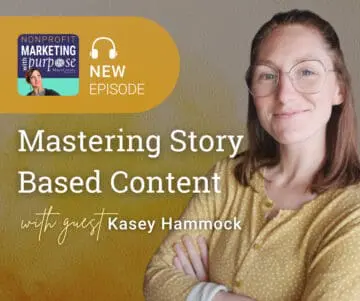
Mastering Story-Based Content with Guest Kasey Hammock
October 28, 2022
CONSUME CREATIVELY
This content is available in:
AUDIO
TEXT
Writing about your organization can be scary. And asking for money can be even scarier.
So it’s not a wonder we develop an unrelenting case of writer’s block when it comes time to craft our fundraising asks. They combine both into the perfect cocktail of yuck.
In this episode, Kasey Hammock, storyteller and conspirator for good, explains what story based content is and how to keep it ethical and organized. She shares how she gathers stories and gives us a recipe to use when writing our fundraising asks.
Say goodbye to scary writing fears and hello to Kasey!
Episode Highlights
Introducing Kasey Hammock, Local Conspirator for Good – 0:58
What is story-based content? – 3:18
What is ethical storytelling and how is it used? – 5:10
How to use storytelling to meet your goal – 11:42
How to find and gather story ideas – 14:48
Tools to use for storytelling and testimonials – 19:35
How to craft your story – 21:54
How to recycle content for multiple platforms – 27:30
Ask for help with storytelling – 30:56
Full Transcript
Monica Pitts
Hello again. And welcome back to Nonprofit Marketing with Purpose. Today I’m super excited because we are going to interview Kasey Hammock. And the reason I brought Kasey on this episode is because when it comes to year-end giving, when it comes to fundraising in general, people get really caught up in what to say. And, and not everybody is comfortable writing, just because you’re director of development doesn’t mean that you’re a journalist or that you’re a creative writer. And it doesn’t mean that you’re super comfortable in this sphere. But it all has to start somewhere, right? We have to learn from these experiences. And one of the things that Kasey does in her business is help people with just this very thing. So today, she’s going to talk to us about writing story-based content and how we can incorporate that into our fundraising asks, and yeah, so without further ado, Kasey, why don’t you introduce yourself and your business and tell us about you?
Kasey Hammock
Hey, thanks for having me today, I’m Kasey Hammock with Partner for Better.
I help uplift local nonprofits by helping them really tell their very best stories through grant writing, year-end reports, white papers, all of those ways that they can connect with different audiences to both build their support base and the money that they need to do their absolute incredible work in our community.
And I’m really passionate about this topic of storytelling, because people do get really caught up with it. And it can in some ways be broken down to a science. So I’m so excited to dig into that.
Monica Pitts
Yeah, what I love your title that you have given yourself. So tell us your job title.
Kasey Hammock
Yeah, I am your local conspirator for good. I know a lot of people in the traditional sense would say that I am a consultant. But I really prefer the title conspirator for good because I don’t see myself coming into organizations as someone who’s just going to tell you what to do, what’s not going well, what’s broken, I am a social worker.
I want to come in and tell you what you’re doing well cheerlead you on and conspire with you for your incredible mission and help you do your best work.
Monica Pitts
Now, those of you guys who listen often have probably heard me asking the questions that Kasey helped me craft for our donor management system interviews, because we’ve been interviewing people about their donor management software. And so this is this is Kasey, now you actually get to meet her. This is very exciting. So thank you again for that, because that was really helpful. And those interviews have been really fun. I’ve learned so much about how people manage their donor data and why they pick what they do. And I’ve even gotten some ideas for my own marketing, too from it. Like I had a couple big lightbulb moments while I was interviewing a couple different people. So it’s fun. You guys can listen to those two. Okay, so getting down to business, the first thing I thought that we should do is just talk about like, what does story-based content mean? Because I kind of feel like it’s a it’s almost like a buzzword. It’s like when people say white papers, or people say SEO like What in heaven’s name, is it? So what does it mean? Can you define story based content for us, Kasey?
Kasey Hammock
Yeah, absolutely.
Story based content is really starting with a story that you think is going to connect with the audience you want to connect with, by showing an example of a population that you’re working with and your nonprofit, or really exemplifying the work that you’re doing.
And instead of doing that with just facts and numbers, or broadly describing the service that you’re providing, you’re talking about what it is like to be a part of your service, or what it is like for a client who has been a part of the service that you’re providing.
Monica Pitts
I’ve seen some of our local nonprofits do this very, very well in their year-end giving letters and somehow managed to keep everything including the ask all on one page. How are you amazing, like, wow, and I read them and I feel like what this person is going through, and it really does motivate me and and helped me understand the need, because I think that it’s not just motivating me to give it’s also helping me understand that the need is there and that my money would go to help this type of person. So one question that I hear often from nonprofits is, do the stories have to be read Your actual stories of people? Or can it be something that’s almost like a combination of experiences? Like, tell me about that?
Kasey Hammock
Yeah. So before we even start talking about creating the stories, I think we have to start with an even bigger concept. And that is ethical storytelling. And this is the concept that any story we are telling about someone else, and even if that’s someone is kind of a collection of stories, we have permission to tell that story. And we are telling it in a way that is true to their experience, and not cherry picking the details that best fit with our mission, or the story that we’re wanting to tell. So that can be really tricky when you’re pulling a bunch of stories together. And while that can be effective, particularly, if you’re wanting to tell a story of like, generally, the type of clients that maybe utilizes your service, and what that’s like to walk through the process, that can be okay. But when you start getting into more specific details of for example, you know, maybe we serve a single mom who has three kids and no car, and this is how we supported them.
If you have a specific client or clients in mind, it’s important to fact check with them, and really involve them in the storytelling process.
So actually working with clients not only to just get those short snippets when you’re doing reviews with them and trying to get testimonials, but involving them in your year and giving asks, having advisory boards and say, you know, we want to tell the story of what it’s like to work with us. And we want to honor your experiences, both as a part of our system and more broadly as a human and letting them be a part of that. And while that can be scary for nonprofits, to involve people in something so important as your year-end fundraising, I think that you would be surprised how powerful the stories will be when you let those who are having those experiences tell them.
Monica Pitts
So I think what I’m hearing is, if you were just describing, like, say on a services page, we help young moms with multiple children who often don’t have transportation, that type of a general story, like just, that’s okay. But then when we are going to tell a story, maybe with somebody’s name, or give like the actual experience, then that should be not just cherry picked, but more. Making sure that we’re actually telling the true story that happened. And we’re not like fabricating parts of that person’s story.
Kasey Hammock
Yeah, absolutely.
Monica Pitts
And especially for young nonprofits, I could feel where this would be an interesting situation. And a lot of people start and the only story they have is their own. Yeah. And that’s why they’re starting with this. Any advice that you would give them? Is it okay to share your own story when you’re getting started?
Kasey Hammock
Absolutely. I think that that can be super powerful as well.
In general, I would say writing story-based content is a combination of art and science and a little bit of magic.
And some of that magic comes from the founders and the individual individuals who are at that nonprofit. Because there’s a reason they’re there. And when you can start with the mission of the organization, and telling that story of why you’re passionate about it. Those stories can be just as powerful as telling a story of a client.
Monica Pitts
Now I know that every nonprofit has like a different tone. So some nonprofits have like their tonality is very bad. Like when I see the commercials come on with the sick dogs. I’m like, oh, no, I can’t do this commercial. I need to change the channel. Right. Yeah. And that sort of tonality. And I understand that, that what that’s what they’re doing, right. What a lot of the nonprofits that we work with, they want to have a much more uplifting tonality, right? And they want to show, okay, very short bit, this person is not okay, too much longer, but this is how they’re okay now that we’ve helped them, and that’s kind of their story structure when they tell the stories, it’s like maybe a sentence or two about what their life was like before they help them, and then going into the revitalization of this person’s life, right? And I’m sure everybody can have their own tone in their own structure. But how do we make sure that we’re not like victimizing the people that we’re telling the stories about? Like, I mean, I guess it’s one thing with dogs and cats in cages. But then humans are kind of a different scenario.
Kasey Hammock
I think it goes back to involving those clients in the story that you’re telling, and making sure that they feel okay with the way that they’re being represented. And I think we’re really specifically talking about social service nonprofits right now. other nonprofits have different challenges, right? Like arts nonprofits, being able to tell the story of how important culture and creativity is in our community. And that’s a totally different story. So I feel like each sector has those unique challenges.
Ultimately, what it’s going to come down to is, how are you connecting with your audience? So what is your strategy?
What is the story that you’re wanting to tell? What is that why, and starting there, and kind of working backwards, then into the specific story you’re wanting to tell.
Monica Pitts
I completely agree. When we did a round of testimonials a few years ago, I sat down and I was like, This is what I want. The testimonial was down. Like, I want it to be this. And like, we wrote down what I felt like my perfect testimonial was going to be that I was going to get out of people. And then I had to think So what questions do I need to ask people so that way, they can say, things that are similar to what I just said. And we broke it down into the questions. And the reason that I wanted the testimonial, like that was because I felt like that would alleviate some of the fears and, and like buying roadblocks for people considering buying our services, right. So it was all there. And I think that you kind of have a similar concept to like breaking down this art of storytelling, you were saying before we came on air that you feel like it all starts with a goal. Do you want to take us through, like, your mentality there?
Kasey Hammock
Yeah. And I feel like I have a perfect story for working through this. So at the last local nonprofit that I was the executive director at First Chance for Children, I sent out a monthly newsletter. And those newsletters were fairly short. I sent out one every single month and at the beginning of the year with my marketing committee, I would create a strategy and we would say, one, what is our overall tone going to be for this year? What is our goal that works within our fundraising strategy? Are we trying to get more donors this year? Do we want to increase our audience base, and then let’s break that down month by month and tell stories that are different every month, but kind of weave together throughout the year. And so then I would start each one of those monthly newsletters with a different story, some of them including more facts and numbers, other about specific experiences that individuals have had.
And by far the newsletters that received the largest response, were ones that came, frankly, directly from my heart about the realness that was happening within the nonprofit in that month.
And people just can connect to those experiences of human to human, what it can be like in some of these different fields. And so by starting with that goal each year, we were really able to think about then that strategy, what story do we need to tell this month and what tools do I have around me? What experiences have I had as a leader? Do I know that my clients have had that I can then utilize to reach that goal.
Monica Pitts
And as you’re going through your day to day, even as the executive director, you’re thinking to yourself, actually, I don’t even think to myself, that’s probably actually overstating it. It’s like I just had this low level awareness of what’s going on, right? You’re just you’re present. And when you hear the story, you’re like, Wow, this is amazing like that. Thank you for sharing, first of all, to whoever told it to you. And then that’s like that moment where you’re like, Okay, I need to remember that this needs to be the thing that goes in the newsletter, because it’s important, right? Because I do this that is a challenge for people is just seeing those special moments like and remembering them. Because what we do every day is not what everybody else does every day. And so it’s our my goal, usually, to communicate, hey, this is the coolness. This is the fun stuff like this is what you didn’t know. Are there other ways that you find those stories? Do you do like an ask, like you mentioned advisory board? Maybe you ask your board itself?
Kasey Hammock
Yeah, so a couple of other strategies, but one keeping that strategy. On top of mind, I am a really visual person, if you could see my desk right now it’s covered in sticky notes. And so when I would have those everyday moments that I would think to myself, like, wow, this is really powerful, I would just write it down on a sticky note, and put it on a cork board or put it on my computer screen. So I would have that for later. And then I’m super nerdy. So I always had my annual strategy pinned up on my wall, next to me. So every single day, when I came into the office, I looked at that strategy, I looked at my year end goal. And I would have that to start my day. But some other strategies to getting those stories.
Number one is involving your team. They’re the boots on the ground and as a leader, making sure that you are involving them in the entire organization and helping them understand how critical their work is not only for the population that you’re serving, but also for the organization’s success, is super critical.
In my weekly staff meetings, we would have a question every single week about you know, what is going well, what is once and then there was a specific question of like, what is one special thing that you saw this week, whether that was something that happened with a client, something with another team member or something out in the community, and just really highlighting those special moments from every single team member every single week, is a great place to start for building some of those stories.
Monica Pitts
I also feel like the people who like if you are lucky enough to have extra help support around the office administrative folks, people that answer the phone, they always have the best stories, and they can, all you have to do is ask. I love it, you know, well, you if you’re not at the front desk all the time, then you don’t get to interact with everybody. And I feel like especially those of us who are in a higher level position within an organization, you can lose touch with everything that’s going on. And so I love that you’re you’re reaching out on a regular basis and asking like, what, what is your experience? Share it with us? That’s such a fun thing to celebrate.
Kasey Hammock
Yeah, I will say Jamie Freidrichs really helped me build that strategy of leaving time in my calendar every single week to meet with someone and ask them why they’re passionate about our organization, whether that was a donor, or a board member, or even just taking a staff member to coffee to having that special one on one time. Just every single week, asking someone about their story really helped me both build that content. But it’s really it’s more than that, right? It’s also staying passionate about the work that you’re doing. And building that energy within the organization.
I think also when people have the opportunity to tell their story, they leave those experiences feeling more empowered, more excited about your mission, and more willing to be that cheerleader and tell someone else about your organization as well.
Monica Pitts
One trick that because I you know, I love technology. So I feel like the most important thing to make sure you don’t do though is don’t forget, like this story, right? And so Kasey uses sticky notes. I use this program called Millanote and they make like little like I literally will make screenshots of stuff from social media stories and posts and then I just saved the images into this one specific board. That’s my like storyboard. I think you could use a Google Doc.
Kasey Hammock
Yeah, there’s Google note does the exact same thing. And I’m a huge Google product user, and they have the same thing. And it’s really easy. You can have it on your phone and your computer and your tablet. And then you never lose those sticky notes.
Monica Pitts
Yes, it’s so important. And the other really fun app that I would encourage you to try out when you’re having some of these conversations if people are willing. There’s an app called Otter, and it is a dictation software. And I have many times asked like, is it okay if I record this conversation, because what I want to be able to do is go back in and remember it exactly the way that you said it. Because when you’re interviewing somebody, and they, they’ll say it, and you like, get this feeling inside, you’re like, wow, I could not have said that any better. That was so powerful. And you can try to sum it up on the other side. But if you have it recorded, and you can, like hear it again, if and especially than if it’s transcribed, then you can read and find the moment instead of having to listen to the whole 30 minute or however many long conversation. So Otter is another great free app that you can use for that I’m sure you can use notes too.
Kasey Hammock
Ditto on otter, love that software, too.
Monica Pitts
So all kinds of fun tricks, folks, you just got to pick the one that really works for you. So as far as like storytelling in like a written class, that’s that’s, you know, sort of what we’re talking about today. Any advice on that any recipes that you use to make sure that you get it right?
Kasey Hammock
That’s a great question. I think it depends on the medium. So the story is that I tell particularly now, when I’m working with different clients, and different nonprofits are really different based on the medium. And when we talk about medium, I’m thinking about email, written letters, social media, handwritten, thank you notes, don’t forget about that as a storytelling opportunity, it’s going to be different, because the goal of each of those is different, right? So again, you have to go back to what is the goal for this specific communication that you’re providing. And I like to start any communication that I’m doing with that, why. So at the very beginning of that communication, telling the person why you’re communicating with them, and then maybe moving into a story that you think is going to connect with that audience. For some audiences, that is going to be more numbers and facts, dry information about X program provides x number of meals in this county. And some people do just want to hear that for others, they want to hear about that particular mom or family and their experience and what it meant for them to receive that food. And then you want to close with this specific ask that you have for that individual or for that specific communication. So in a thank you note that is going to be you know, your donation helped us do this, or thank you for meeting with me and telling me your story. This really makes a difference in social media, it might be we need you to share this post so others can hear this story. And then in a fundraising letter, it might be we need $100. So we can help another family just like this one.
So starting with that goal in mind, and kind of having three major sections is a really great recipe for meeting those goals.
Monica Pitts
I love that. And especially whenever I write, if I’m writing an ask or even an email, if it’s asking somebody to do something, there’s like a part at the top of my Word document where I’m like, What is the goal of this thing? And what are the points that you think you need to hit and then half the time I’ll start, I’ll just start writing. And I’ll forget one of the points until I go back up and look at that review. And that’s one of the things that at the top of all of our year-end giving email templates we have up at the top it’s like what is the purpose of this email? Like I wrote it up there for people so that way I’m here anything they can be like, Isn’t achieving this purpose? How can you achieve the purpose? So, I Yes, I love that. So we’re going to recap that one. So the first thing you said is, why are you communicating. And that’s how you start off your, your communication with them. And that’s the part that I stick up at the top. So I don’t forget, you can word however you want. This is just my outline, right? And then you go into a story. And I’m really glad that you mentioned that a story doesn’t just necessarily have to be about people. It can also be a story that’s crafted with with numbers or this making a point through a dialog. Yeah. And then you close with your ask like, what do you want them to do, and that you said depends on the medium. So for social media, it might be share, in your actual letter, it might be fill out this form and mail back in a check. Or it might be scan the QR code, go out to this website, like whatever it is. So you use the same story, then kind of like, adjust it for your mediums, is that what you do?
Kasey Hammock
Yes. Both shortening it, lengthening it adding subtracting details, you can really use the one major theme, and then change it for each of those mediums. So for example, at first chance, I would write a lot of blog posts. And then I would take that blog post, and maybe shorten it add some different details for a newsletter, which has an audience that likes more facts and details. So add in some of those. And then I would change it again for Facebook, where I’m going to make that much shorter, a couple of sentences and link back to the blog post. And then on Instagram, we’re going to make a really nice graphic, maybe put one sentence on there and say that the link to the full information is in our bio. And then if it’s a really powerful story and does well across all of those, I might consider keeping that information for our year end report, which would have a completely different format as well. And then as we’re writing grants, which I love helping organizations do, stories can be super powerful. And if there’s one that works well, let’s figure out how to put that in a grant application or a letter of intent on your cover page.
Monica Pitts
I love the recycling. Recycling is awesome. And it’s not just for bottles. Yes, it’s for content to and few brands like if, if an email does well, you can use it again. If like, especially if it’s over the course of years, right? Like, yeah, if your social post does well, or even if it doesn’t do well, you can pull out another part of that story and highlight that and put that out in another social post, maybe with a different graphic. So you can kind of recycle even more, because I always tell folks that not everybody’s going to latch on to the same part of your story. And so if you have multiple parts of your story, especially for social media, you can break it into little chunks and then think this one’s for the mothers. This one’s for the grandmothers. This one’s for the fathers, you know, and make sure that you’re talking to everybody about what maybe they want to see.
Kasey Hammock
Monica, should I tell them my secret? You don’t know this secret either.
Monica Pitts
I want it.
Kasey Hammock
Okay. I used for about two or three years, the pretty much same social media campaign for my year-end giving, and also my email newsletter strategy.
I took what worked each year and cap it and then added a new details switched up sometimes some of the graphics but sometimes not. And nobody ever knew. And it was super successful.
We raised more money every single year by building on what worked pulling out what didn’t. And it saved me hours and hours and hours.
Monica Pitts
Yes, we do this same thing with CoMoGives. I won’t lie. It is because, and for those of you who don’t know CoMoGives is Columbia, Missouri, which is more than Columbia, Missouri, though, because now we have multiple counties in it. But it’s the community’s year-end month-long online giving campaign that’s powered by the Community Foundation of Central Missouri and MayeCreate is lucky enough to get to be the digital media sponsor and web development gurus behind it. And years ago, I was like wow, look at the conversion rate on these email. So this is crazy, like these people are so likely to donate. And so I made a whole series of them. And we go in and we added them every year and like for the last three years, they’re not. I mean, we switch out data to make it relevant. We switch out dates, but, but the shell of the email is the same, right? You know it because because it worked last time so we keep using it. It’s gonna convert at 40%. I like that email. Not all of them do, though. Just the GivingTuesday one. So anything else I like, as we’re wrapping up this conversation? Is there anything else that you want to tell people about writing story based content, integrating it into their fundraising asks, you’re the expert.
Kasey Hammock
Yeah, I think I would just like to end with if you need help, I am here as a resource. Those stories belong in your organization, they are one of the most powerful tools that you have. And if you’re not sure where to start, if you need someone who has some fresh eyes to tell that story, give me a call. And let’s figure out what that looks like for your organization. Because you are doing incredible, incredible work.
I don’t even know which nonprofits are listening. But I already know you do incredible work. And I know that you have stories to tell that deserve to be told. And let’s help you do that.
Monica Pitts
It is a lot easier to tell them when you’re from the outside looking in. It would actually be easier if like, if you’re a nonprofit, and you don’t like to write about yourself, maybe you just call the nonprofit next door and you write all their stuff, and they write all your stuff. And you just let it back and forth. Because it is so much easier to tell the story when it’s not your own, you know, cuz it’s hard to write about yourself, hard. But we’re here for you guys. Okay, and so Kasey will help you out. Also, remember that there’s all those free resources out on Mayecreate.com. We have everything from free GivingTuesday email templates, that people who go through our year-end giving training, get a whole month worth of year-end giving emails, and social media. So like it’s there for you, we are going to hook you up with things that you can edit and make your own to. Alright, so, Kasey, if they need your help with storytelling, or grant writing, you’re in rapport? How do we get a hold of you?
Kasey Hammock
Yeah, the best way is to go to my website, it’s partnerforbetter.com. And I’ve got all my contact information there. You can also find me on LinkedIn and Facebook. And I’m happy to connect and grab a cup of coffee and see how we might be able to work together. Yeah, or should I say conspire for good?
Monica Pitts
Ask for the conspirator for good. Cause she will conspire goodness for you as well. Well, thank you so much for joining me today. I always learned so much from you, and hopefully everybody else did too. So keep planning that year-end giving you guys, it is an amazing time of year to ask for donations. And until next time, go forth and market with purpose.
Who Manifested This Madness?

This fabulous human, that's who.
Monica Maye Pitts
Monica is the creative force and founder of MayeCreate. She has a Bachelor of Science in Agriculture with an emphasis in Economics, Education and Plant Science from the University of Missouri. Monica possesses a rare combination of design savvy and technological know-how. Her clients know this quite well. Her passion for making friends and helping businesses grow gives her the skills she needs to make sure that each client, or friend, gets the attention and service he or she deserves.