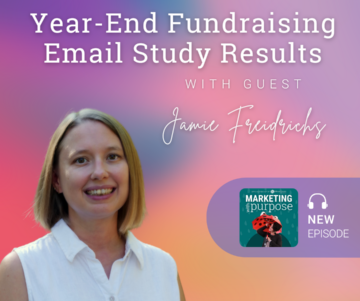
Year-End Giving Email Study Results with Guest Jaime Freidrichs
November 15, 2024
CONSUME CREATIVELY
This content is available in:
AUDIO
TEXT
If you’ve ever wondered, “How many emails should we send in our year-end campaign?” Turns out, you’re not alone!
We get this question every year, and now, thanks to Jaime Freidrichs, a fundraising coach dedicated to helping small but mighty organizations succeed, and 71 nonprofit survey participants — we’ve got some real data to guide you.
In our latest episode (and blog post), we dive into the findings of Jaime’s study on the 2023 year-end email strategies of 71 nonprofits running online campaigns to understand:
- How frequently successful nonprofits emailed their supporters.
- The sweet spot for sending emails (without overloading your supporters).
- Surprising stats on email volume vs. meeting fundraising goals.
With this survey Jaime hopes to take at least SOME of the guesswork out of your year-end email strategy.
Featured Resource
Year End Campaign Planning Checklist
Don’t give up! There’s still time to make December your biggest giving month yet!
Get Instant Access!Year-end giving is a crucial time for nonprofits, with nearly 30% of annual donations arriving in December. So how many emails should nonprofits send to maximize donations without risking an unsubscribe surge? A recent study by Jaime Freidrichs, analyzes the email strategies of 71 nonprofits participating in the CoMoGives campaign and sheds light on this question.
For over six years, Jaime has been guiding small nonprofits to fundraise effectively with limited time and resources. As a fundraising coach, she helps these “small but mighty” teams maximize their efforts and see strong results.
One of the top questions she’s asked every year: “How many emails should we send at year-end?” Conventional wisdom suggests that more emails boost donations, but Jaime has always hesitated to give that advice without solid data to back it up.
Seeking Real Data on Year-End Email Frequency
When her graduate students at Arizona State University recently asked the same question, Jaime realized just how much this advice lacked a data-driven foundation. She scoured scholarly resources for clear answers but came up empty.
Turning to CoMoGives for Answers
That’s when Jaime thought of CoMoGives, an annual online giving campaign supporting nonprofits of all sizes and types across central Missouri. By surveying CoMoGives participants, she saw a chance to gather real insights into whether sending more emails really drives results—or if the conventional advice needs a refresh.
Each nonprofit in the study set a year-end fundraising goal for 2023. This allowed Jaime to objectively analyze the relationship between the frequency of emails and the actual fundraising outcomes, giving her study a solid benchmark. Nearly all donations were made online, so this research is particularly relevant for organizations aiming to improve year-end online fundraising.
The goal of the study:
Determine how many year-end giving emails to send.
Through her study, Jaime aims to answer a key question for all nonprofits:
How many emails should you actually send to see the best results at year-end?
She hopes the findings of her study will give nonprofits of all sizes a clearer, data-based path forward to make the most of their year-end giving campaigns.
Key insights from the data include:
- Total Donations: These 71 organizations raised $993,212 collectively in 2023, accounting for 48% of the total amount raised through CoMoGives.
- Fundraising Range: The amount raised by each organization ranged from $160 to $101,260, covering organizations across the leaderboard.
- Email Frequency: Organizations reported sending between 0 and 26 emails during the campaign.
- The median number of emails sent was 3.
- The average number of emails sent was 4.
- Nine organizations reported sending no emails.
- Email Planning:
- 56% of organizations sent exactly the number of emails they intended.
- 36% intended to send more but ran out of time.
- 8% sent more emails than initially planned.
- Postal Mail: Only 20% of organizations sent postal mail requests that included a link for CoMoGives donations.
How many emails should you send in your year-end giving campaign?
The study’s findings point to a sweet spot for year-end email frequency that can help nonprofits increase donations without pushing unsubscribes too high. Here are the top insights to guide your next campaign:
The Sweet Spot: 4-7 Emails for Year-End Giving Success
The data showed that organizations sending between 4 and 7 emails during the holiday season had the best fundraising outcomes. Sending fewer emails can mean missed opportunities, while sending more may risk losing subscribers. Here’s what the numbers say:
More Emails = Higher Success in Meeting Goals
Nonprofits that hit or exceeded their year-end campaign goals tended to send more emails. Specifically, the top 25% of organizations who raised 96% of their goal or more, sent an average of 5 emails, compared to lower-performing organizations that sent fewer.
Unsubscribe Rates Increase with High Volume
Nonprofits that sent 8 or more emails saw unsubscribe rates climb, with some organizations experiencing rates as high as 3.95%. But don’t let a higher than average unsubscribe rate during the month of December. Unsubscribes are normal. They’re also a natural way of keeping your email list current and filled with people who want to hear your message
The takeaway?
To maximize donations and keep unsubscribes at a minimum, aim for 4-7 well-timed emails between Giving Tuesday and December 31.
Should you send a monthly newsletter to your donors?
Yes! Another key finding from the study was the effectiveness of consistent, year-round email engagement.
Monthly Emails Drive Success with No Downsides
Among top-performing nonprofits, 76% emailed their supporters at least once a month throughout the year, and were more successful in their year-end campaigns than those who did not.
Increased Goal Achievement
The study showed that most top-performing nonprofits emailed their supporters at least once a month. Monthly emails appear to help build strong donor relationships and set the stage for successful year-end campaigns.
No Downsides to Monthly Outreach
Unlike high-frequency year-end emails, monthly engagement showed no negative impact on unsubscribe rates. Regular contact helps keep supporters connected without overwhelming them, making it more likely they’ll respond to your year-end asks.
The takeaway?
Consistent monthly emails throughout the year are a no-risk way to keep supporters engaged and boost your year-end results.
Key Recommendations
For nonprofits seeking to optimize year-end online giving campaigns, the study offers these actionable recommendations:
- Send 4-7 emails between Giving Tuesday and December 31 to maximize donations without causing high unsubscribe rates.
- Commit to monthly emails throughout the year to build rapport with donors and increase your chances of reaching year-end goals.
By using the right email frequency and maintaining consistent, year-round engagement, nonprofits can not only achieve their goals but also strengthen their donor relationships, paving the way for future campaign success.
A huge thank you to Jaime Freidrichs for her dedication to helping nonprofits reach their fundraising potential. And also to the 71 participating organizations in this study. Without your contributions this would not have been possible! The study and the participants truly embody the heart of CoMoGives, we are stronger when we work together!
Connect with Our Guest
Jaime Freidrichs, Fundraising Coach
Connect with Monica & the MayeCreate Team
Who Manifested This Madness?

This fabulous human, that's who.
Monica Maye Pitts
Monica is the creative force and founder of MayeCreate. She has a Bachelor of Science in Agriculture with an emphasis in Economics, Education and Plant Science from the University of Missouri. Monica possesses a rare combination of design savvy and technological know-how. Her clients know this quite well. Her passion for making friends and helping businesses grow gives her the skills she needs to make sure that each client, or friend, gets the attention and service he or she deserves.