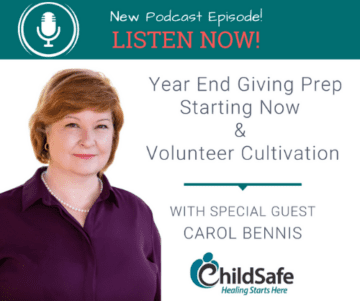
Year End Giving Prep Starting Now & Volunteer Cultivation with Guest Carol Bennis
April 1, 2022
CONSUME CREATIVELY
This content is available in:
AUDIO
TEXT
Today I have a very special guest with me, Carol Bennis. Carol participated in our Year-End Giving Training activity workshop thing last year. During our breakout sessions, we talked about campaign planning. She really wowed me with her tactics and how she managed her volunteers and just projected this like highway of how she was going to cruise through and get the awesomest campaign results ever. So I wanted to invite her here with me today to share with you guys how she does this. That way, you guys can learn a thing or two and maybe also run an awesome year-end giving campaign.
Podcast Summary Notes:
Monica: So to kick us off, Carol, why don’t you tell us a little bit about yourself and your organization and what you do there?
Carol: Sure. Thank you so much for having me this morning. My name is Carol Venice, I’m the executive director of ChildSafe Colorado.
ChildSafe provides therapy to victims of childhood trauma that results from abuse and neglect. About 70% of our clients have been sexually abused as children. Sadly, the need continues to grow. The demand for our services has more than doubled in the past 10 years. Last year, we almost served 1100 clients, which is mind boggling to me. I don’t live in a major city, so it’s shocking. But we’re grateful that they’re finding us.
My background is predominantly marketing, marketing strategy, and strategic planning. When I took the helm of ChildSafe, fundraising was the number one priority. In fact, I believe I have seven bullet points in my job description that reference some form of raising money. So, needless to say, I got the message and raising funds was the most important thing I could do for this organization. So that’s what I’ve been doing for more than three years now.
Monica: How long have you guys been running a year-end giving campaign at the end of the year?
Carol: Well, ChildSafe is currently in its 36th year, but they’ve never had a year-end appeal until I arrived in 2019. So our year end campaign is three years old.
Monica: For some organizations, it’s really a cornerstone of their fundraising – is it becoming that way for your organization?
Carol: Absolutely. This past fourth quarter, we just had a phenomenal campaign.
Things really are starting to build for us in that fourth quarter arena, and people are really starting to understand the benefits of supporting ChildSafe. So, yeah, it’s finally coming along.
Monica: Now, I know that you’re the executive director; tell me a little bit about the support system that you have to help you fundraise for ChildSafe?
Carol: Well, as you can imagine, the vast majority of our staff are clinical therapists. That’s what we do.
I have five members of the administrative team, two full-time team members and three part-time team members. The three part-time members are administrative assistants – they do billing, they help me on the front desk, they do a variety of projects, predominantly for me. Then I have an operations manager who’s responsible for our finance, our bookkeeping, our human resources needs and our facilities needs. The final person is a marketing and events manager who manages all of our events, manages our monthly e-newsletter, manages our social media, and a variety of other things.
But we’re pretty lean. About 11% of our total overhead is administrative. Understanding the percentage of admin overhead, fundraising overhead and programming overhead has been a real breakthrough in our messaging. People are very, very impressed. I believe the national average is 20% of the typical nonprofits’ overhead is devoted to administration. So it’s always big news to somebody when you fall below 20%.
Monica: I feel like your ability to run lean is due in part to your ability to effectively manage your volunteers, right? Because it sounds like they’re a really big part of your end giving campaign.
Carol: Yes, they absolutely are.
Monica: Part of what I wanted to talk about was what people should be doing right now to get ready for their year-end giving, because I know that both of us are already thinking about all the different things that need to be done. So right now in March, what are the things that you’re doing right now to make sure that you have an amazing fourth quarter?
Carol: For the last five years, I have been holding all of my individual donations, my private donations–not from grants, not from sponsorships, but gifts given by individuals–side by side for the last five years. I’ve been trying to understand who is stretching in their support for our organization, who’s starting to pull back, who has lapsed, and who are the new donors.
Knowing this, I can speak to them in very different ways. So I am segmenting my target list right now. I’m understanding where the activity is, where the momentum is, whether somebody’s starting to slip away from me. I need to interact with those individuals right away. If somebody is doing more, I need to interact with those individuals right away.
The other thing that I’m doing right now is I’m looking outside of my organization. I’m looking at other nonprofits in my geographic footprint, and in my industry space and understanding who is giving to them, because they’re the people who care about kids.
And what I do is an important service for people who care about kids. So I am doing some significant prospecting right now and by the end of the first quarter I should have a significant list of new prospects. I found these names on other people’s websites, in their social media, on their annual reports, and some organizations still acknowledge donors by giving levels.
I’m trying to understand who’s out there. I’m looking at Style magazine, which is a publication in northern Colorado, where photos are published after major fundraising Gala’s from other nonprofits. I’m looking at the names and the captions to say, “Hey, who’s going to their events? Why aren’t they coming to mine? And why aren’t they a donor?” So I’m gleaning that information in every possible way I can get my hands on it.
The most important way I’m finding that information is I’m asking my volunteer board, who do you know, who can you introduce me to?
Who do you know? Who are you aware of? Can you give me an email introduction? Can you and I meet with this person? Do you just want to slip me the information and never mention your name ever again? No, tell me what works for you. And I find that I got a lot of engagement from my board by taking that approach. I won’t lie; more than 50% of my recommendations come in the “please don’t tell them I told you” category. But I also have the board members who are saying, you know, “Hey, I’m on the board of this really great organization and I’ve copied the executive director. I want you to meet her so you can learn more about it. I think you’ll be as passionate about this organization as I am after you have a conversation.”
So those are really valuable and it really amps up your engagement time significantly, when somebody will personally introduce you. My poor friends are always slipping me names or ideas. And if I don’t hear from people, I’m always saying, “Hey, what’s going on? What are you doing? That’s new? Who have you met? Who should I know?” You know, I’m that friend.
In addition to doing donor serving once a year, I reach out to my most loyal donors.
I have that conversation with them, first of all, to see how their experience is going. Because I recognize that when somebody writes me a check, and especially if somebody writes me a significant check, there is an incredible euphoria that follows. People are so excited, they’ve been able to do something of this amount for you. And I think that when you’re fundraising, it’s important that you engage while they’re still in their state of euphoria, while they’re so excited to hear what their donation is going to do for the community, and how it’s going to be used in this organization. And, we have really clear examples of where individual donations are invested in our organization. So I say Never give up. Never stop asking and always ask your donors because they know people.
Monica: I think it’s great that you guys have the people in for the open houses, because you’re showing them that you are providing a great quality service in a really comfortable atmosphere, that you’re a good steward of their investments by making this amazing and transformative experience for the people that you serve, which are kids, but then to you’re also explaining them that you still have needs and those needs include things like paying for the building.
Carol: Exactly. And they get to meet the therapist. My therapist will lead or they’ll guide personal one-on-one tours and explain what happens in each room and what neurofeedback is. If people don’t want to engage, we have a self-guided tour.
In every room, there’s a little placard describing what goes on in the room, why we do it, why we have our therapy, why we have play therapy, why we have a therapy dog, and so forth. This is so you can learn our story just by walking through the building. Or you can have somebody tell the story and you can ask questions.
Monica: So it sounds like right now in March, your year-end giving planning steps include reviewing all of your data, reviewing how you did last year and where it came from.
Making sure that you really understand who the people are who contributed, who the people are maybe who didn’t contribute. That way you can formulate the message and the ways that you’re going to communicate with them throughout the year to deepen your relationships so that you have the ability to have a meaningful ask at the end of the year.
It sounds like you’re also doing competitive analysis and researching for new donors and those are some really creative ways that you describe. I especially loved the example that you said that you’re looking at the back of magazines and all the pictures from all the galas and the names – You’re like a detective right now too. So you’re really deep into the planning and detective thing.
Carol: Thanks. Thanks. I just know that there are a lot of people who want to do a lot of good things in our community. And I see my job as being in the invitation business.
I’m in the invitation business. Let me help you do good in our community. I’m not really in the administration business or the fundraising business. I’m going to find a way to invite you to participate any way I can think of all year long.
Monica: I like that mentality. Because I think a lot of people think about fundraising. They just say it’s asking for money, when, in actuality, it’s building a relationship and then giving a person an opportunity to get involved.
And if you think about it, asking for money doesn’t work. My kids did a read-a-thon with their school. They were so pumped about asking everybody to donate. They thought it was the coolest thing. And I thought, “Wow, this is crazy,” because adults don’t think of it like that. They were just very excited. And then, with some of the money that they earned, they did a missions outreach initiative where they went and bought clothes for refugee children. They were so pumped that they got to do this thing for these other people. My kids are excited to be involved in helping someone else. I think adults have that excitement too. They are just busy and they get caught up. And you’re giving them an opportunity to feel that excitement.
Carol: I think you need to capture those philanthropic hearts when people are very, very young.
On Fridays when we don’t have clients in the building, and on Saturdays, if I have somebody who says they don’t have time to take a building tour, but I know they have children, I will invite them to bring their kids to do a little volunteer project with me on the weekend for a couple of hours. So they come and of course they see the building. Sometimes they’re refitting the hummingbird feeders on our back deck, or sometimes they’re just refilling all the snack baskets we have throughout our building for kids and they get very excited about that.
Those people will get excited about seeing the light go on in their children’s eyes when their kids realize they’re helping people.
All I have to do is have some juice boxes and some snacks. And we usually have some old race T-shirts from our prior 5k – they can pick out the one they want. The kids go away elated about helping other kids and those parents don’t forget that. And then they respond differently the next time we approach them.
Monica: I like that you give the kids these hands-on projects that they can really do because just having kids write letters or do thank you cards feels like busy work.
When my daughter was 11 she wanted to have a peer-to-peer fundraiser through CoMoGives for people to donate stuff for her birthday to other children. I explained to her, “You have to do it on behalf of an organization and then the money goes to the organization.” She asked, “So I don’t get to buy presents for the kids and go give them their gifts?” I had to tell her, no, that’s not really how it works. Then she didn’t want to do it. She wanted to shop for the presents and give those presents to the other children.
Carol: I get it – it’s really important to them, even something as simple as filling our snack baskets.
I ask them; “Do you think we have good snacks? What else should we be getting?” and I have them write it down on a list. They get to contribute, they get to brainstorm and give an idea. It’s such a simple donor cultivation tool, but it really works. People turn me down all day every day when I offer facility tours. But when I tell them about the little kids clinic to open kids eyes up to why they should help others volunteering, nobody’s ever turned it down.
Monica: And I think that’s because you know your donors.
Because a lot of people don’t realize that to get people my age involved, you’re going to probably have to involve my kids. I don’t go to the galas very often anymore, because of all the prep involved – getting a babysitter, etc. I’ll just write you a check instead. But you want me there because you want me to hear your story and become further invested. Involving the family members I think shows that the research that you’re doing is good.
Carol: And it’s really kind of important to think beyond how you normally identify prospects or potential donors.
By thinking way outside of the way the organization has traditionally identified prospects in our case. I’ve reached out to area churches and asked them if the weekend after Mother’s Day they’d help us plant flowers in our beds. I had volunteers planting flowers for me, and I had one of our college interns going around with a popsicle basket so everybody could take a popsicle break. We had lunch served and it was everything that people love but wouldn’t normally do for lunch, you know? And so people got to engage with us and got to know our persona. And then and then they walked away with a different opinion.
We’ve tried to identify unique potential donor audiences by going outside of the box.
Yes, I participate in nonprofit fairs, but we’re also doing some things well off the beaten path because we really want to differentiate who we are and how we do it. We have a lot of people over the age of 60 come to plant flowers for us and who didn’t hesitate to write a check the following week. It’s a personal connection that will really shorten your lead time in securing a gift.
Monica: What made you think of managing this volunteer delegation the way that you do it? What was happening before you started this way that made you think this is going to be awesome?
Carol: We did our first year-end appeal in 2019 and it was “Oh, my gosh, it’s September. Why has there never been anything like this before?”
So we concentrated on scrubbing a really good list, writing a really decent letter, including one little reference tool and getting them out to see what happens. And then we did okay. I think we raised about $15,000. That first year, we thought, “Okay, that’s awesome. Let’s start planning for it.”
When Colorado Gives day was happening, we had volunteers doing their volunteer projects. And I noticed that they were constantly going back to somebody’s desktop to refresh the thermometer on where we stood. They were really excited about that.
So what I did for the past two years was to build in some opportunity to take advantage of that excitement.
So, for example, we pulled together some very simple graphics that we posted on our Facebook page, and our volunteers knew on Monday, Wednesday and Friday we were going to have new content for them to share with their followers. We had 100% participation. It was the easiest thing for me to ask them to do. And before they hit post, they would write a personal comment to everybody they’re connected with. That was the first opportunity.
We also did some very simple, inexpensive postcards for people to take with them. We had a pre-printed message and a portion of the panel for them to write a personalized message to that recipient. I had one volunteer send out 125 postcards. The second year was crazy and it resulted in some donation activity, which was a lot of fun.
Monica: So with your volunteers, it sounds like you have them really involved from the beginning with the sharing of social posts
And I really like how you guys have made it as easy as possible for them. Because that’s key, right? They’re just not there every day, they don’t see it, they don’t understand what they could be posting. So by giving them the posts, you’re making it as easy as possible for them to do this thing for you. And the postcards. You’re not just saying hey, write a letter, you’re like, hey, here’s the postcard. And even making them part of the envelope stuffing.
You’ve said that you pair your volunteers with their strengths. And then you also have a Google folder for your year-end activities that you share with people like you have a needs list of things that have to be done. And you make sure to show them how much needs to be done. So how does that work? Do you just email it out to everybody? And you’re like, here’s our Google folder with all the stuff in it, or like, what is that? What does that transaction look like?
Carol: The first week of September, we do send the link to the Google doc out to all of our volunteers, including our board, because we all have a tendency to forget that our board or volunteer, they’re members of our volunteer corps as well.
They just have a deeper commitment to the organization. And so I will share that the first week of September to say ‘here are all the things we need help with, here are the job descriptions, this is what you’ll be doing, this is who we’d be working with, this is what we estimate to be the amount of time necessary to do this job.’
And this job can be done remotely. This job has to be done during business hours, but you can set your schedule, you can work, you know, all of these days, during these hours, just let us know what would work best for you.
So essentially, all it is, is we’re providing them with a menu of ways they can help. And again, by clarifying, clarifying, clarifying, giving them everything they need to know, and then when they get there, making sure they have everything they need to do that job.
Monica: And so when you send the invitation, with the Google Doc, you’re inviting people who might not even have that monetary resource, but have a skill that they want to share with you.
And then, from what I understand, they literally assign themselves a job. I’ve found that if I am volunteering for something, I need to be managed. I need to have somebody check in on me to make sure I have everything I need and that everything is okay. How often do you check back in with people once you’ve given them their tasks?
Carol: Well, there are a couple of touch points during that process.
When somebody signs up and they tell me what they can do and which day(s) they can do it, I put that on my calendar. My calendar has info like Barbara said she would do this assembly for us and she’s bringing the two of her friends, whose email addresses and mailing addresses I’m getting from Barbara. She doesn’t know that yet, but she’s gonna provide those because I’d like to send a handwritten thank you letter when it’s done. But essentially, when I see that they’ve signed up, that’s something I check at the end of every day and add to my calendar.
Monica: I have to know, with all this strategy and all of these things that you’ve implemented, what did you do before you were an executive director?
Have you always been in the nonprofit industry? Or did you do something else before, because you’re really creative about this. You’re really passionate and creative. So I just wondered if this has always been your journey, or if there was something that brought you here.
Carol: I’ve been in and out of the nonprofit world my whole career.
I’ve worked in lots of for profit situations where I’ve done business development. And if there’s anything that jumps out at me from the for profit corporate business development world, is that people like to be thanked. People like to be remembered. So my Salesforce has all kinds of interesting little quirky things, the names of their kids, if they ever mentioned them, things like that. It just becomes part of your processes, business development. It really is.
In business, it’s a rarity for somebody to get a handwritten thank you note.
So yeah, I order thank you notes 250 at a time. And every day, I look at my calendar and look at my interactions. I say, “Who do I need to write a thank you note to?” Because somebody is going to open that and just feel like, “Oh, my gosh, she wrote me a note. You didn’t have to write me a note, you could have sent me an email or said thank you when we talked.”
It’s just really kind of interesting to see how people react to really simple niceties. It’s not extravagant, it’s not something that’s going to require a lot of effort on your part. But it makes a huge impact.
Monica: And it sounds like it’s a healthy way for us to develop an attitude of gratitude.
I feel like people who are thankful are happier in life and so it could almost be like your own journaling therapy every day to write your thank you note to everyone else who makes everything possible, right?
Carol: Just like that donor’s euphoria, every time I sit down and I think about something specific to the individuals I’m writing to, I feel great.
Sometimes I do it first thing in the morning. Sometimes I do it right before I leave. I will admit to doing it while watching television when I get home because I didn’t have any time to do it at the office, but it’s important to me to get them out the same day. Get them in front of people. People need to feel your gratitude, gratitude is palpable. And, people’s delight in helping you and absolutely having no question they’re helping you is important.
Monica: So we’ve covered so many things during our discussion today; how you’re preparing for your year-end giving, doing your homework right now, how you’re inviting people…
How you’re a “Master of Invitations.” I think that’s so fun. And also how you’re getting your volunteers involved in deepening those relationships and giving them the opportunity to help your organization. Now, to wrap it up, I was just hoping that if you had a word of advice, or like a most important thing about running your year-end giving campaign to offer to our listeners, before we wrap up?
Carol: Sure. If you have a staff, I would encourage you to invite everyone’s participation in helping.
I have a clinical staff, so I have very little daily interaction with them. So when we have an all-staff meeting, I will ask them then. I’ll let them know what is coming up and I’ll tell them, “I’d like to make some Thanksgiving cards available to you,” or “I’d like to make some year end appeal letters available to you. Who would like to help?”
I get 100% participation because of course everybody wants to help.
So I would encourage you to invite everyone to participate. People will tell you what they can and can’t do. And I say that nothing’s off the table. Ask for the introduction. If they can’t do an introduction, ask for all the contact information. You know, unless of course, they can do a face to face introduction. That’s gold. Never stop asking the people who are already connected to you to help. You don’t have to do it all on your own.
Monica: So Carol, why don’t we wrap this up by you telling us where people can go learn more about your organization?
Carol: Well, you can find us online; our website is childsafecolorado.org.
You can also find us on Facebook, we’re on Instagram, we’re on Twitter, we’re on LinkedIn. Please feel free to connect with me. I’m always happy to share information. I think it’s one of the most important things that an organization’s leader can do to help other organizations. It just keeps the good stuff moving forward. So don’t hesitate. I’d be happy to help.
Who Manifested This Madness?

This fabulous human, that's who.
Monica Maye Pitts
Monica is the creative force and founder of MayeCreate. She has a Bachelor of Science in Agriculture with an emphasis in Economics, Education and Plant Science from the University of Missouri. Monica possesses a rare combination of design savvy and technological know-how. Her clients know this quite well. Her passion for making friends and helping businesses grow gives her the skills she needs to make sure that each client, or friend, gets the attention and service he or she deserves.