The Future of Online Ads with Guest RJ Huebert
April 10, 2026

CONSUME CREATIVELY
This content is available in:
AUDIO
TEXT
What’s Actually Working in Online Advertising Right Now
Many business owners think of ads like a light switch. Flip it on, leads pour in. Done. That’s not how it works — and if someone told you it was, they lied to you.
The good news is ads absolutely can move the needle. You just need the right channel, a solid offer, and a few things in place before spending a single dollar.
Let’s take a look at what ad channels are working right now and how to make the most of them.
The Two Channels Worth Your Money
If there’s something visual to show — a finished project, a before/after, a product — Meta is the place to be.
The demographic, interest, and behavioral targeting is powerful, and right now CPMs (cost per 1,000 impressions) are running around $2–$4. Here’s a reality check for small business owners: in the grand scheme of things, most people have no idea you exist. Paying $2–$4 to introduce yourself to 1,000 of your exact target audience? That’s not an expense — that’s an investment.
Google is bread and butter for high search intent.
Someone searching for a plumber, an HVAC company, a specific service — they have a problem right now and want an answer. That’s a completely different buyer than someone passively scrolling their feed.
If your customers know they need you, Google Ads is the place to be.
HVAC and plumbing are dream clients for Google Ads. Their customers know what they need and when they need it. When someone’s AC dies at 95 degrees in July, they don’t browse Instagram — they grab their phone and search. They click the first thing that looks legitimate and they call. That high-urgency, I-need-this-fixed-right-now search intent is exactly what Google ads are built for, and campaigns like that can convert beautifully.
Others are a needle in a haystack.
On the flip side, if people don’t know what you do or haven’t even considered your product or service as a solution to their problem targeting your potential clients using Google Ads will feel like finding a needle in a haystack. For example, consider a company that sells custom-bound history books to corporate boardrooms — beautifully produced, expensive, and designed for a very specific executive audience. Trying to find those buyers on Google is (and was) painful. The search volume barely existed. The cost per lead was brutal. That client probably should have been on LinkedIn targeting by company size, industry, and job title instead — where the right decision-makers were actually spending time.
The point: the right channel depends on your product, price point, and competitive landscape. Every dollar matters in a small business, so don’t pick a channel because someone told you to — make sure it actually fits your situation.
What Makes a Great Offer (and What Tanks)
When crafting your offer ask yourself: if someone doesn’t take it right now, will they feel a pang of regret?
Your offer has to feel valuable enough that missing it stings a little.
For product businesses, a time-limited discount can do that — “45% off this weekend only” creates urgency that’s hard to ignore. For service businesses and nonprofits, the best offers are often informational. Give your audience something they genuinely need, an answer or a piece of information they’ve been digging for but no one else seems to offer up.
Give people what they actually need and watch what happens.
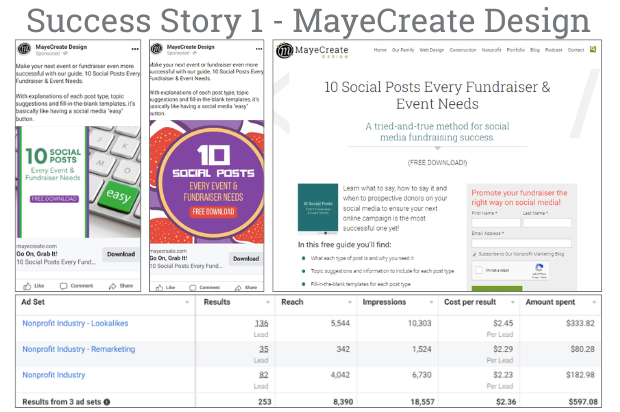
A lead magnet MayeCreate offers 10 Social Posts Every Event and Fundraiser Needs, targeted at nonprofits. Specific, useful, free to download. HBT Digital managed an ad campaign on Meta for this download with the goal of generating email subscribers for MayeCreate. That campaign generated email subscribers for $2.36 each, far lower than the average $6 per subscriber most campaigns see.
The offer worked because it wasn’t about money. It was about identifying what that audience desperately needed and handing it to them. They downloaded it, trusted the source, and stayed in the funnel. Months or even years later, when they needed a website, they already knew who to call.
Successful ads are rarely a one-step process.
The best campaigns warm people up before ever asking them to buy. A valuable piece of content gets them in the door, builds trust, and by the time the conversion ask comes — they’re already sold on the source.
HBT Digital’s 34 Ways to Succeed with Google Ads guide promoted on Meta is a good example of this in action. Someone downloads the guide, gets invited to a live walkthrough the following week showing how to actually use it, and at the end of the webinar learns about ways HBT works together with clients to manage their online ads.
Meta leads came in at $5.36 each, and by the time someone showed up to the webinar they’d already gotten real value and were genuinely interested. The conversion ask landed because the trust was already there. It’s more work to set up than a single ad pointing to a contact form — but the quality of leads that come through is dramatically better.
What doesn’t work.
“Free consultation.” Everyone offers that. It doesn’t differentiate anyone — and honestly, “consultation” is often interpreted as “sales pitch.” Why would someone choose you over the five other people saying the exact same thing?
If a free consultation is genuinely the offer, make it worth showing up for. Give it a name that describes what they’re actually getting. “Free 15-Minute Website Audit” beats “free consultation” every time because people know exactly what they’re walking away with. Spell out what you’ll cover, what they’ll learn, and why it’s valuable even if they never become a customer.
Better yet, consider offering something smaller first. A downloadable guide, a checklist, a short video — something that delivers real value with zero commitment. Low stakes, easy yes. Once they’ve gotten something useful from you and trust that you know what you’re talking about, the invitation to a consultation feels a lot less like a sales pitch and a lot more like a natural next step.
One thing that can make or break your entire campaign – congruency.
A successful campaign is aligned from start to finish — the ad makes a promise, and the landing page delivers on it. When that chain breaks down anywhere along the way, the whole thing falls apart. And it breaks down more often than you’d think.
One of the most common mistakes found in ad audits is sending traffic to a generic contact page — just a form, no testimonials, no client logos, no reason why anyone should reach out to that specific company. Just because there’s a form doesn’t mean people are going to fill it out.
In Google Ads, congruency actually shows up as quality score: does the keyword match the ad copy, which matches the landing page? But beyond the technical score, it matters for the actual human on the other end. They clicked for a specific reason. If the landing page doesn’t deliver on that exact promise, they’re gone.
Keep it simple: one offer, one message, one landing page.
When you try to do too much at once — multiple messages, multiple services, multiple calls to action spread across a thin budget — you end up with results (or lack there of) you can’t make sense of. It’s like a science experiment where you changed all the variables at once. Your seventh grade teacher would have given you a zero — because you can’t draw a conclusion from results you can’t isolate. Something might be working. Something might be broken. But there’s no way to know which is which. Start with one thing, learn from it, and build from there.
Some landing page friction is OK if it fills your pipeline with the right people.
Most business owners assume more leads is always better. It feels counterintuitive — even a little scary — to intentionally filter people out. But your landing page isn’t just there to capture leads, it’s there to capture the right leads.
Yes, you need a form people are actually willing to fill out — that part is non-negotiable. But everyone filling out that form isn’t necessarily what you want. You want the right people filling it out.
You’re busy. You have a business to run. Spending time on discovery calls with people who were never going to buy, can’t afford your services, or aren’t even in your industry is time you’re not getting back. A little intentional friction on your landing page — the right qualifying questions, a starting price point, a clear description of who you actually serve — means fewer conversations overall but dramatically better ones. Quality over quantity isn’t just a nice idea. When it comes to leads, it’s the whole game.
How to qualify leads on your landing page:
- Put your starting price point at the top of the page.
In small print is fine. It sounds counterintuitive, but it works. The people it scares off weren’t going to buy anyway. The people who keep reading? They’re already self-qualifying. - Ask the right questions on your form.
Go beyond name and email. Ask for revenue range, current ad spend, industry — whatever tells you before the first call whether someone is actually a good fit. The goal isn’t to make the form intimidating, it’s to make sure the conversations you’re having are worth having. - Be clear about who you serve.
If you only work with established businesses, say that. If you specialize in a specific industry, say that too. The right people will feel seen. The wrong ones will move on. Both outcomes are wins.
Strategies to run ads on a small budget.
You don’t need a massive budget to run effective ads — but you do need to be willing to put enough money in to actually get something out. Ads have to be shown enough times to generate real data, real clicks, and real conversions. A minimum of $50 a day — roughly $1,500 a month — is a reasonable starting point. Below that, your ads simply won’t show up enough to move the needle.
If you’re trying to figure out how to run ads on a small budget without wasting money, these strategies are a good place to start.
1. Keep it simple, and keep it consistent.
Most marketers tell you “don’t put all your eggs in one basket”. But if your budget is limited that may just be the ticket to your success. Remember, alignment is key – one offer, one message, one landing page. Put your whole budget behind the one product or one service you do best that brings in the most business for you, not the whole menu. Then use your other marketing and sales channels to sell your other products or services.
2. Time your ads for best results.
A small restaurant probably shouldn’t be running a full Google campaign. But $10 in Meta ads, running only between 4 and 7pm on weekdays, promoting a happy hour special? That’s targeted, timely, and cheap. It hits people right when they’re getting off work and thinking about where to go. It doesn’t need to be complicated or expensive to be effective — it just needs to match the moment.
Not sure when your specific audience is actually on Facebook? Meta Business Suite’s Audience Insights shows you exactly when your followers are most active — use that data to time your ads instead of guessing.
3. Get the technical foundation right first.
If your tracking isn’t set up correctly, you’re flying blind. You won’t know which ads are converting, where your leads are coming from, or whether your budget is working at all. So before running a single ad, make sure the pixel is installed from whichever platform you’re using and conversion tracking is set up properly. On Meta, that means connecting the Conversions API — if you’re on WordPress, there’s a plugin for it — which significantly improves the quality of data coming back.
4. Use what you have to get more of what you want.
Cold audiences may be inexpensive to advertise to but they are expensive to convert. Starting with people who already resemble your best customers means your budget goes further because you’re not starting from zero.
Warm up your audience by building out custom audiences from people who already know you: people who’ve visited the website, engaged with social content, or are on an existing customer list. Meta can take a list of 100 existing customers and find lookalike audiences that share the same attributes. That’s a powerful way to find new buyers who already resemble the people who’ve said yes before.
5. Process the data so it works for you.
Most people think about ads as something they set up once and leave running. But the platform is constantly learning, and the more you feed it good information about who converted and who didn’t, the better it gets at finding the right people for you and the farther your budget will go.
So if leads start coming in that aren’t a good fit? Mark them in Meta’s lead center. The platform will actually stop showing ads to people like that group — and start finding more people like the ones who did convert. The system gets smarter the more it’s fed.
6. Set a realistic timeframe to experiment before pulling the plug.
Like any other experiment, online advertising takes time to uncover the right campaign for your business. One month isn’t enough to know if anything is working. It takes at minimum three to six months to gather enough data to learn what’s converting and what isn’t. Walking away after 30 days because you didn’t close any deals means leaving before the real learning even started — and you’ll never know how close you actually were.
Not everyone needs to run ads.
Before pulling out the credit card, it’s worth asking whether ads are actually the right move right now. Ads might not be a good fit if your budget is under $1,500 a month, or if your product or service price point is very low. Oftentimes a small budget can’t generate the sheer volume of conversions you’d need to make a $5 item worth advertising. The math has to work before the ads can.
The pipeline problem nobody talks about.
And sometimes the budget isn’t even the issue — it’s what happens after the lead comes in. If your website is confusing, nobody’s following up, or you don’t have a real process for working new leads, fix that first. Ads will just pour water into a leaky bucket. You can generate plenty of leads that never close if nobody’s working them. That’s not an ad problem — that’s a pipeline problem.
Sometimes your phone is the right answer.
If your budget is tight and you already have existing relationships, the fastest path to new business is often just picking up the phone. Yes, the phone. And yes, in an article about online ads – but really the goal of your ads is to generate business, right? Well sometimes the fastest way to do that is with some good old fashioned networking and relationship building.
Reconnect with past clients. Build referral partnerships. Have real conversations with people who already know and trust you. Those conversations will generate revenue faster than ads for the same investment.
The Bottom Line on What’s Working
What’s moving the needle right now is not magic, not massive budgets, it’s just smart decisions made in the right order. Selecting the right channel for your audience, creating an offer worth stopping the scroll for that leads to, a landing page communicating the right thing to the right people, and enough budget and patience to let it actually work. Remember, every campaign that looks effortless right now likely has years of testing behind it. And if you’re just getting started, you’re not behind — you’re just getting started.
Who Manifested This Madness?

This fabulous human, that's who.
RJ Hubert
RJ Huebert is the founder of HBT Digital Consulting, a Pittsburgh-based online advertising agency specializing in lead generation, paid ads, and full funnel marketing systems. He's been helping small and mid-sized businesses generate predictable leads online since 2019 — and yes, he actually answers the phone. Find RJ at HBTdigital.com or growth.HBTdigital.com, and on social at @HBTdigitalconsulting.