Online Presence 2026: Same Fundamentals, Different Reasons
October 16, 2026
CONSUME CREATIVELY
This content is available in:
AUDIO
TEXT
The internet has been declaring things dead for 30 years. Websites were a fad. Blogs were a fad. SEO was a fad. Now everyone’s panicking about AI search like it’s going to burn everything down and start over.
Here’s the deal: the fundamentals of a healthy online presence haven’t changed. What gets you found online in 2026 is the same stuff that got you found in 2017. It’s just that the stakes are higher now because now people have a choice in how they get their information.
Waaaay back in 2017, we did a literal tour of conventions explaining to businesses and organizations what they needed to do to be found online. Because there were a lot of new moving pieces in the internet scene back then – the explosion of inbound marketing and live streaming video. Facebook lives, that’s right! But interestingly enough, the knowledge gap, then and now, is about the same. In 2017 everyone was focused on the new bright shiny object when what they really needed was to focus on the fundamentals that get the job done. And with AI on the scene the story really hasn’t changed all that much. But the data points have.
What’s a healthy online presence in 2026?
Some people think a good online presence means a pretty website or an active social following. Others think it’s ranking #1 on Google or showing up in AI answers. And all of them are right-ish. A pretty website (with awesome content) and an active social following are ways to build an online presence. Ranking well on Google or being referenced in AI are results of a healthy online presence. And in 2026, you can’t have one without the other.
A healthy online presence has always had two jobs:
- Help the right people find you
- Convince them to work with you once they get there
That hasn’t changed. Let’s talk about what it looks like now.
What changed?
Search stopped being the same for everyone.
Back in the day search used to be the same ten blue links for everyone who typed the same phrase. Not anymore. Every person now sees a version of the results shaped by their own history, their own phrasing, and what the AI thinks they actually meant.
So tracking “where you rank for a keyword” is one tricky biscuit because it’s a different result for basically every person who searches it.
Now on to the elephant in the room: AI.
Should everyone be freaking out and redoing everything to get found in this new era of search? That would be a hard no.
AI overviews didn’t replace SEO, they just changed how people consume information. And even then, it depends what people are searching for.
Informational queries are hit the hardest.
Now the “what is” and “how do I” searches are swallowed whole by the AI answer. Click through rate is down on these types of searches by 58%.
Here’s the thing though, even though AI overviews are gobbling up the traffic from your informational blog posts that doesn’t mean that blogging is dead. Those blog posts are what power AI overviews. And if your post is used it signals strong relevance and value to Google. So when someone searches for a local business to work with, your site is more likely to show up because Google considers you an authority. That blog post is still doing its job. The job just looks different now.
Good News: Local searches are less fazed.
Currently, AI overviews are scarce in local searches. Which is indeed good news because it means the businesses with the smallest marketing budget are still fishing in a fairly normal pond.
Take a local financial advisor. Sure, people are asking AI where to put their retirement money. But what actually matters for that advisor is showing up when someone searches “financial advisor in Columbia MO,” and people still do that in search the old-fashioned way. And Google is serving up search results the same way we’ve seen them for years: in the local pack, with a map.
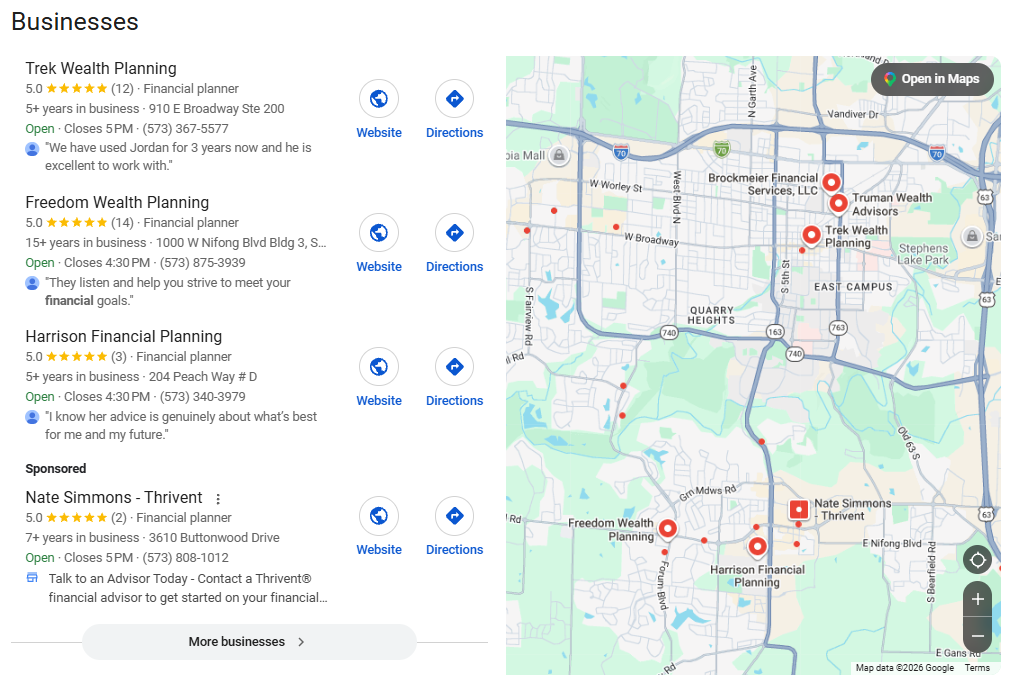
But “fishing in a normal pond” doesn’t mean you can just ignore your online presence and go about business like it’s 2017. You need to cross your t’s and dot your i’s more now than ever. We’ll dig into that in a bit.
Google cares if people are searching for your business name.
This is really cool. In 2026 Google is equating people searching for your business name as a trust signal. It’s now the strongest off-page factor influencing the ranking of your content.
All that direct traffic, people typing in your domain because they know it, people searching your business name – used to just be proof your other marketing efforts were working. And now all that hard work is paying off ten fold, because Google is interpreting that traffic as you having a business that doesn’t suck!
You get a cookie for doing the right thing. Sign me up.
What hasn’t changed.
(But the stakes are a lot higher.)
These aren’t new ideas. They’re the same fundamentals from 2017, they just carry more weight now because AI and search engines are relying on them even more heavily to determine if you’re a credible business worth surfacing. Here’s what Google’s looking at when it’s deciding if it wants to show your business in search results:
- Your Google Business Profile (GBP)
- Listings and Directory Info (Citations)
- Reviews
- Site Speed & Technical Soundness
- Original Content
- How people act on your site and interact with your search listings (Behavior Signals)
- Updated Content
Where you’re trying to rank changes the math.
Whether you want to show up in the local pack and maps in Google Search, organically for local search results, or in AI search, all of these things factor into your online presence. However, their importance shifts based on where you’re trying to rank.
For example, the information you physically have on your site determines:
- 33% of your likelihood of ranking in local search results
- 24% of your visibility in AI search
- Only 15% of whether you show up in the local pack or maps
And how people act on your site or interact with your search listing is more important for ranking in the local pack or organic local search results, 9-10%, than it is for AI search at 4%.
But they all matter. Some are easier to attain than others. And like anything else, it depends on your competition as well. Now, any overachiever (or someone selling these services) would tell you “to have a good online presence you need to address EVERYTHING!”
But I’m a realist. What you can’t do is go all ostrich head in the sand and ignore this stuff. That’s a recipe for disaster. My advice would be to pick what you can handle and do it right.
Your Google Business Profile
Businesses love to overlook their Google Business Profile. I gave whole presentations about why it was important and how to use it back in 2015. Because it was important THEN. And people are still ignoring it. It was a mistake then and it’s an even bigger one now: GBP signals now make up 32% of what determines whether you show up in the local pack, up from 25% just two years ago.
Local Pack/Maps
Local Organic Search
AI search
Having a profile is non-negotiable. If you’re a local business, showing up in the local pack is the number one way people find you. At the very least, make sure your name, address, phone number, and hours are correct.
Over the past year, actually interacting with your profile got a lot more important. Post to it. Interact with it. Treat it like social media, because honestly, it might be the most important social media work you do.
- Posting more often: worth 8% more than it was a year ago
- Uploading photos regularly: worth 5% more
- Answering your Q&A section: worth 4% more
Basically now in addition to the first optimization of your GBP, you need to continually add photos, respond to reviews, and post occasionally. This is about as close to free money as local SEO gets, and most businesses still leave it sitting on the table.
Listings and Directory Info
You don’t need more listings. You need the ones you already have to say the same thing.
Your business is listed all over the web whether you know it or not: Google, Apple Maps, Bing, Yelp, Facebook, industry directories, probably fifteen places you’ve never thought about. The SEO folks call these “citations,” and in 2026 they account for 6% of your local pack ranking, 7% of your local organic ranking and 13% of your AI search visibility.
Local Pack/Maps
Local Organic Search
AI search
Here’s the deal: Your name, address, phone number, and category need to match everywhere. Businesses with 95%+ consistency across all data sources rank 2.1× higher in local pack results than businesses with 80% consistency.
WHAT?!?! Yeah that’s what most people say when I explain this…your stuff needs to be the same all over the web down to the way you abbreviate your office suite. Because even if you do all the other stuff right and your information is inconsistent another company with consistent information can outrank you. Gross, right?
Just a few months ago we had a client call in upset, saying, “I don’t understand, I’m not getting any calls.” We looked into it and she had the wrong phone number listed across multiple directories. It had just never gotten updated, so someone’s phone was ringing, it just wasn’t hers. That’s the kind of thing that seems small until you realize it’s been quietly costing you leads for months.
If you have moved recently, got a new phone number or just don’t have a good handle on your listings (which is basically everyone) Moz Local has a free listing checker, use it to make sure yours are accurate.
For businesses with inaccuracies, we use Moz Local’s paid service to go out and correct their information across the board. It fixes a lot of listings automatically, but Google, Apple Maps, Facebook, your local chamber of commerce, and a few others still have to be done by hand. It’s genuinely simple work with a big payoff.
Reviews
Still one of the most important local signals. What’s changed is Google got smarter. It’s on the look out for spammy-looking reviews and review consistency. And in 2026 steady beats bursty. A handful of new reviews every month outperforms ten in one week followed by ten weeks of silence.
Local Pack/Maps
Local Organic Search
AI search
We suggest building review requests into specific moments in your process rather than sending one giant mass email to your whole client list at once. Ask right after a key moment happens and the client is likely to leave a favorable review. For a lot of businesses that’s right after an office visit or at the end of a successful project.
Most client management platforms even allow you to automate the email so you don’t forget. Building it into your workflow like that keeps your review velocity steady instead of feast or famine.
Site Speed & Technical Health
Your site can’t load like a turtle.
Slow websites suck. For users and for your online presence. Google made page speed a ranking factor back in 2021 and it’s still a hard hitter. Which is why we run tests on every single website we build before we call it done.
Here’s something people don’t think about: your home page is almost always the slowest page on your site, because it’s got the most stuff crammed onto it, and it’s also the page people visit the most. That combination makes it the most important page to get right. Secondary pages usually load faster simply because they don’t have all the extra fluff.
Keep page speed in mind as you plan out your home page. You might really want that cool video or social feed for the experience it gives visitors. Fair enough. But if it tanks your load time, Google isn’t going to reward you for it. Ask yourself: is this component more important than a potentially lower ranking? If yes, fine, keep it. If not, find another way to make the page engaging that doesn’t kill your speed. Tools like PageSpeed Insights will show you exactly what’s dragging you down.
Keep up with broken links & 404 errors.
Google also looks at your site’s technical health. And if you’re not a developer there may not be a ton you have control over in that arena but you can at least clean up your broken links and 404 errors.
Broken links are easier to track and fix than you think. We use the WPMU DEV Link Checker plugin. It gives a list of broken links as well as what page they’re on and what they’re linked to. Making the process of updating them pretty straightforward.
404 errors occur when a page isn’t available anymore. A site reporting thousands of random 404 errors reads as neglect to Google the same way it does to a visitor. Because Google is sending people to your site for information it thinks exists and people are getting an error page. That’s about the equivalent of sending them to your office only to find you’re closed or don’t offer the service they went there for.
404 errors are less straightforward to fix. If you rename a page, or combine the content from two pages and delete one you can easily create a 301 redirect to the new content. Now if you’re just retiring content, like a staff member leaves or you don’t want to offer a service anymore, you will just need to leave it alone and Google will resolve them and drop them from its index eventually. Just like anything else with website maintenance, you need a protocol to handle the content coming on and off your site. Different content needs to be redirected differently and fixing it after months of negligence is tedious, but a 404 error mountain will inevitably lose trust with Google.
Original Content
This is the only content that actually wins now.
Original data, an actual case study, a process explained by someone who’s done it, not summarized it. In 2025, content quality accounted for 23% of what the search algorithm is looking for when determining if content will be valuable to visitors and it’s currently rising.
On Page Signals
Local Pack/Maps
Local Organic Search
AI search
Personalization
Local Pack/Maps
Local Organic Search
AI search
The quality of your content is largely dependent upon what’s now called ‘information gain’, basically how much unique value a page adds beyond what’s already sitting in the index, and it’s the strongest predictor of whether a page actually ranks in 2026.
It has nothing to do with how long the article is. Writing a thesis over a topic already covered by all the sites in your genre will not get you ranked, no matter how clever your keyword strategy is. And publishing something ChatGPT could write in ten seconds is working against you now, not just failing to help you.
Behavior Signals
Another reason that original content is even more powerful isn’t just in the content itself; it’s in the results of publishing it.
Because it’s original content, Google will be more likely to show it and AI will reference it. And as a result of that, people will be more likely to click on the search results and visitors will stick around to read it.
Local Pack/Maps
Local Organic Search
AI search
All of this signals back to Google that what you have is high quality. Google is watching what people do on your site and how they interact with your search listings. And as clicks are going down, the relevance of the items that actually are clicked on, and how people act on your site, is going up, 23% to be exact.
Which is awesome. Just one more cookie for doing the right thing. A site that’s easy to use, provides quality content, and keeps visitors coming back is rewarded with high visibility in search results.
Between 2024 and 2026 behavior signals jumped in strength:
- Return visit rate +28%
- Time on page +19%
- Pages per session +15%
- Click-through from search pages +22%
- Scroll depth +18%
The original content concept doesn’t just need to be applied to a blog post, it needs to be applied to all the pages on your site.
When you’re building your services pages, don’t just give people a bulleted list. You need to explain what they need to know to make a buying decision, down to the philosophy of why you do it that way, and include a list of the frequently asked questions that they’re most likely going to ask.
We see this play out every time we rebuild a site, our own included. We go through, rethink the content, make sure it’s framed right. Even when it’s covering similar ground to what was there before, it reads better, loads faster, and is organized more logically. People stick around longer and scroll further. Google notices, starts showing it more, and traffic creeps up. We see a real spike within months of a new site launching, on our site and on client sites both. It’s not a fluke. It’s just what happens when the fundamentals are actually done right. And now Google is actually rewarding you for it.
Regularly Updated Content
Back in the day it was important to add content to your site regularly so Google would index the site more often, and you could build out entry points for visitors by covering different topics relevant to their buying journey.
And that reason still stands. It’s just measured differently.
We used to look at traffic to a page as a marker for success. And while the practice is still equally important, the payoff is far less tangible. It shows Google you’re a topical authority and improves content freshness, and trustworthiness. Those three factors make up 23% of what Google’s algorithm looks for when sharing content in search results.
It’s not one and done. You need to update it.
Pages updated in the last 90 days hold their rankings noticeably longer than pages nobody’s touched in a year.
This means as you add content to your site and it gains Google’s affection, you have to keep that content current or you’ll lose traction. Again, this isn’t just on your blog. It’s on your whole site:
- Is your pricing still right?
- Is your FAQ current?
- Are your hours correct?
- If you give any kind of health or medical guidance, is it reflecting where your expertise actually is today?
Most businesses do an annual content review at best. But the new 2026 data says quarterly is closer to right, at least for anything likely to go stale.
One practical way to handle this without losing your mind: keep a running list of the stuff on your site that expires quickly, and just review that list on a schedule instead of trying to re-read your whole website four times a year.
The Bottom Line
AI is changing search and it will keep changing. But for most of the businesses and nonprofits we work with, it’s not demanding urgent action right now. What actually matters, for AI search, for regular search, and frankly for having a website that does its job, is that your business is easy to find, your information is correct everywhere it lives, and your content actually answers the questions your audience is asking.
That’s not new advice. It’s just more true now than it’s ever been.
And like I said earlier, you don’t have to do all of it at once. Pick what you can actually manage, and stick with it. If I had to tell you where to start, I’d say:
- Fix up your listings, especially your Google Business Profile. Don’t let those go.
- Work through the content on your website. Make sure it represents you the way it should, it’s original, and written in your own voice. Start with your home and services pages, they’re often the most visited.
- Run a PageSpeed Insights report and if it’s not tracking in the right direction talk with your web developer about ways to make sure everything is loading quickly, technically sound, and doing what it’s supposed to do.
- After you get all those fundamentals down then, if it makes sense, you could start a review campaign, blog, podcast or another path to add content to your site regularly.
Don’t go full ostrich on this one, waiting doesn’t make any of it easier or cheaper to fix. We do free 15-minute videos reviews if you just want a gut check on where you stand. In-depth reviews cost more, but that’s usually because there’s more actually worth digging into.
Who Manifested This Madness?

This fabulous human, that's who.
Monica Maye Pitts
Monica is the creative force and founder of MayeCreate. She has a Bachelor of Science in Agriculture with an emphasis in Economics, Education and Plant Science from the University of Missouri. Monica possesses a rare combination of design savvy and technological know-how. Her clients know this quite well. Her passion for making friends and helping businesses grow gives her the skills she needs to make sure that each client, or friend, gets the attention and service he or she deserves.
GET MORE AWESOME
If this trips your trigger you'll love our podcast. Get more episodes just like this on:

You'll Probably Also Dig

Time to get your act together. Start with a conversation.
573-447-1836 | info@mayecreate.com

Our Podcast
What to Put on Your Website

A free page-by-page website content checklist.