From Table Top to Backdrops: Trade Show Booth Display Ideas For Small Budgets
April 4, 2025
CONSUME CREATIVELY
This content is available in:
AUDIO
TEXT
From Table Top to Backdrops: Trade Show Booth Display Ideas For Small Budgets
You know what’s funny? For years now, we’ve been wandering up and down trade show aisles like a couple of booth anthropologists. We’re not just there to collect free pens—we’re studying what actually pulls people into certain booths. This became really important when our clients started asking, “Hey, while you’re building our website, could you also design our trade show booth?” And we said, “Sure, why not?”
So we’ve spent time at some massive national expos, just soaking it all in. And here’s what we’ve noticed: trade shows are basically seas of sameness. Same boring flooring everywhere. Same pipe-and-drape backdrops. Identical tables and chairs. Even the way company names are displayed follows the exact same format.
So what catches your eye in this cookie-cutter environment?
Anything different! Literally anything that breaks the pattern will make people look twice.
Here’s the best part—you don’t need a Fortune 500 budget to stand out. We’re self-described coupon clippers and thrift store shoppers over here, and we’ve found tons of ways to make your booth pop without emptying your wallet.
In this post, we’ll walk through five areas where small, affordable changes can make a huge difference:
- Your backdrop & signage (trust us, this matters)
- Flooring that doesn’t scream “convention center”
- Creating genuine reasons for people to step into your space
- Adding movement that catches the eye
Let’s start from the top—literally—with your backdrop.
I’ll add some catchy subtitles to break up the backdrop section and make it more engaging:

1.Trade Show Backdrops & Signage
Let’s talk backdrops. This is the real estate that everyone sees first—and we’ve designed our fair share of them (including some slightly weird ones… like giant hand-drawn cows. Yes, life-sized cattle illustrations on 10-foot banners. Don’t ask).
The first thing we always consider is transportation.
The first thing we always consider is transportation. How are you getting this thing to the show? That often dictates your options. A beautiful backdrop doesn’t help if you can’t get it to the venue intact or if it takes three people and a dolly to move it.
Go tall or go home.
First, make sure your logo or name is at the top, and second make that top taller than your neighbors’.
Picture yourself walking through a busy trade show—you’re looking out over this sea of people and booths. What catches your eye? The name that’s slightly higher than everyone else’s. If standard backdrops are 8 feet tall, go for 10. That little extra height makes a huge difference in visibility when people are scanning across the show floor.
Backdrop Design 101: Less Is More
When it comes to what goes ON your backdrop, remember this: less is more.
This isn’t the place to write your company history. Keep it to your logo (big and at the top), a few key services in short, succinct phrases, and maybe some attractive visuals. That’s it. For more banner design tips check out this blog post.
Our own backdrop goes from floor to ceiling (taller than everyone else’s, remember?), has our logo, four core services, and some nice artwork. It’s a backdrop, not a novel.

The Thrifty Exhibitor’s Backdrop Solution
Studio-Style Backdrops
You’ve probably seen those expandable backdrops with interlocking parts and a big sleeve that goes over the top. Those look great but tend to be pricier. For a more budget-conscious option, consider something similar to photography studio backdrops: poles on each side with a horizontal pole between them where your banner hangs.
This style of backdrop is much less expensive and:
- Takes up less floor space in your booth
- Is easy to transport (everything breaks down into a small bag)
- Not back-breakingly heavy (I load mine in alone all the time)
- Simple to update later with a new banner
Hang a Simple Vinyl Sign
If you can’t spring for a custom backdrop stand, just replace the standard sign hanging at the back of your booth. Get a vinyl banner printed in your brand color instead of the standard white everyone else has. Instant differentiation!
While backdrops create your booth’s foundation, additional signage can provide versatility and targeted messaging—let’s explore some smart options.
Strategic Signage: Beyond the Backdrop
So your backdrop is handled, but what if you need to say more? That’s where additional signage comes in! Think of your backdrop as your introduction and these extra pieces as your conversation starters. They give you way more flexibility without blowing your budget.
The Banner Stand Triple Play
Got more to say? Consider pop-up banner stands instead of trying to cram everything onto one big backdrop. We often design sets of three for clients—maybe one with just the logo and visuals, and the others with more specific information. The beauty of this approach is flexibility. You can mix and match depending on the event, only bringing the relevant ones.
Pro tip: Think modular when planning these banner stands.
If you have three primary services but sometimes attend events where you only want to promote one, you can just bring that specific banner rather than having multiple complete backdrops made.
The Career Fair Double-Duty Trick
Another money-saving trick: if you also do career fairs (where you often just get a table instead of a booth), design your banner with important info at the top and less critical info at the bottom. Then you can display it half-height on your table, making it multi-purpose.
The Durability Decision
One final note about quality: If you’re using these banners frequently, invest in sturdier models.
The budget ones aren’t made for constant setup and takedown. We learned this the hard way—we started with cheaper stands that we were constantly bending, scratching, and propping up with chairs. At one point, we had one that never stood up properly again after being used outdoors in the wind (pro tip: use bungee cords and a fence for outdoor displays, or get proper outdoor stands with stakes).
But if you’re only using it once a year? The economy model will do just fine.
2. Flooring: Your Secret Weapon
So we discovered this trick completely by accident. Stacy tells it best:
“We were at this massive national trade show—probably the biggest I’d ever been to. I was newly pregnant, so my feet hurt, my body hurt, I just didn’t feel great. As we walked through all these booths, we kept noticing we wanted to linger in certain ones. They felt more comfortable, somehow easier on the body. What was the difference? The flooring! These booths had plush rugs instead of the hard concrete or tile floor everyone else had.”
That’s how we stumbled upon my absolute favorite trade show hack:
buy a rug and change up your flooring.
The Budget-Friendly Floor Fix
Our first MayeCreate rug came from Walmart, and it worked perfectly fine. You don’t use it that long, and it doesn’t get a ton of foot traffic, so it doesn’t need to be super high quality. Our current one came from either Amazon or IKEA (we honestly can’t remember which), but the important thing is that it was really inexpensive.
The biggest consideration? Get a rug that will actually lay flat.
You’ll keep it rolled up in storage most of the time, and you don’t want people tripping over curled edges. While ours doesn’t lay perfectly flat immediately, after about 30 minutes of being unrolled, it settles down nicely. If it’s the difference between a $30 rug and a $40 rug that will actually lay flat, spring for the $40 one. I’m pretty sure I’ve never spent more than $40 on a trade show rug—why would you when it lives in a closet most of the time?
Keep It Simple
You’ll see some booths with professionally printed rugs featuring logos and fancy designs. You can absolutely go that route, but do you really need to? Having a rug in your company colors that fits your vibe works perfectly well. And if you find the edges curling up? Make friends with some duct tape (which should be on your booth packing list anyway).
The Extended Welcome Mat Trick Bonus Tip
Position your rug so it extends slightly into the aisle where people are walking.
Even if it’s just a foot or so, it creates this subtle invitation—”Come on into my home for the week!” It disrupts the pattern of movement and makes your booth feel bigger (and we Americans love our space, right?).
Just make absolutely sure it’s not creating a tripping hazard. Tripping potential clients is generally considered bad for business!
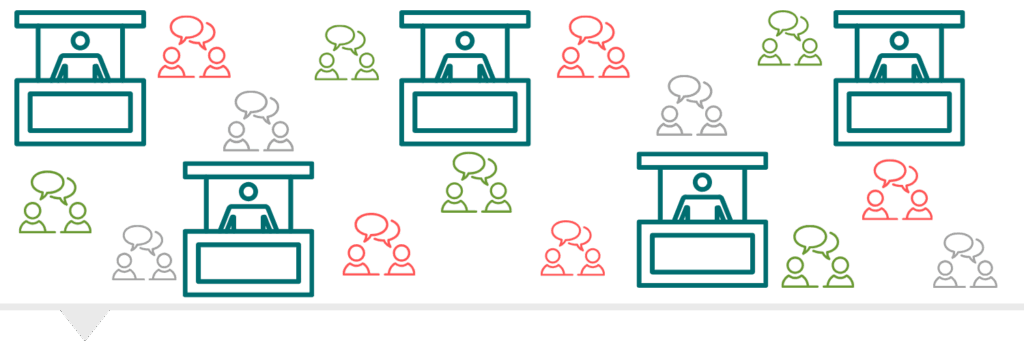
3. Creating Genuine Reasons for People to Step Into Your Space
Before we dive into specific tactics, let’s address the elephant in the room: that standard 8-foot table they provide you.
The Table Trap (And How to Avoid It)
Do NOT leave that giant table across the front of your booth with you sitting behind it! This creates an instant barrier between you and the people you’re trying to talk to.
Remember, the entire reason you’re at a trade show is to connect with people.
You want them to come into your space and have a conversation. Before I even bring my display materials in, I turn that table sideways and shove it against the side of my booth. This way, if someone wants to take something from my table, they have to actually step into my space—which creates an opportunity for conversation.
When that table is across the front, it feels like approaching a teacher’s desk—intimidating and formal. Nobody wants that!
Create Comfortable Gathering Spaces
You want people to come in, sit down, and hang out. Here are some simple ways to make your booth more inviting:
- Bring fold-up director’s chairs (the tall kind, so people don’t feel like they’re imposing and can just prop a hip in your chair)
- Set up a cocktail table near the front where people can stand and lean
- Consider bar stools that provide casual seating without feeling too lounge-y
When you create these comfortable spaces, people will come in, sit down, have a conversation, eat some candy—all the things that lead to meaningful connections.
Show & Tell: Bring Tangible Examples
If you have a physical product, bring it! Create a literal show-and-tell opportunity for people to touch and interact with:
- We have a client who does siding, roofing, and windows—they bring actual samples of materials
- Asphalt companies bring in pucks or sample pieces
- Greenhouses fill their booths with plants
The show and tell strategy can be really inexpensive because it’s stuff you already have. I love walking around trade shows and sticking my hand in whatever gravel or material someone brought to see how it feels. Many people are highly tactile, so if you can bring what you do into your booth, people want to touch it. Which naturally brings them into the booth and that, my friend, is your whole goal, right?
Even if you’re in a digital business like us (we’re web designers—not much to physically show!), you can still bring printed examples of your work.
Giveaway Strategy: Smart, Not Expensive
We’ve tried all the giveaways—including the really expensive ones that we were too afraid to actually give away (they’re still sitting in our office closets!). Here’s what really works:
Interactive Elements: Games and Activities
Creating a simple interactive element in your booth can dramatically increase engagement. One of my favorite examples came from a disability advocacy nonprofit. They hung huge sheets of paper at the back of their booth with markers, inviting people to sign their names as a pledge to remove a certain derogatory word from their vocabulary. It was brilliant! People stepped into the booth, made a meaningful commitment, and the organization accomplished their mission of changing behavior—all with just some paper and markers.
Other things I’ve seen are:
- Simple games like Plinko, bag toss, or putting greens
- Surveys that invite participation
- Interactive displays that align with your mission (like the example of signing a pledge on a large paper)
- Photo opportunities that create shareable moments
The best part? Many of these ideas don’t require expensive equipment—just a bit of creativity and understanding what would appeal to your specific audience.
4. Movement: Catching Eyes and Drawing People In
Last but not least, let’s talk about movement—because nothing catches the eye quite like something in motion. This is especially powerful for grabbing attention in a sea of static displays.
The Magic of Video Slideshows
If you don’t have a tangible product (we feel you!), a slideshow can be your best friend:
Stacy swears by Canva she says, “Anybody can use it to create something impressive, then just display it on whatever screen you’ve got—office TV, monitor, or even just your laptop.”
And I’m not gonna lie, I just made ours in Canva and it looks like a million bucks.
Our previous tradeshop video was a full-on professionally developed masterpiece in Adobe Premiere Pro…that only a video pro could viably update. So, when we needed to update it, I panicked. And then Stacy told me her Canva hack, and with their new AI tools, it automatically applies animations that make it feel like a professionally developed video.
Canva or no canva – here’s a protip: Download your slideshow as a video file and play it on repeat. Don’t risk streaming it—trade show internet is notoriously unreliable.
Display Options That Won’t Break the Bank
Don’t stress if you don’t have fancy equipment:
- A large TV on a stand is nice (that’s what we use)
- Your TV could simply sit on a table
- A computer monitor works perfectly well
- Even just your laptop is totally fine
Use what you already have—especially if you’re on a budget.
Trust us, you won’t be the least prepared person there. There’s always at least one booth with a felt board and velcroed pictures (you know, like the ones from elementary school). Sometimes people even have handwritten information on notebook paper stuck to those boards!
The Human Element of Movement
Sometimes the most eye-catching movement comes from you:
Last year, I walked past a booth six people deep. It wasn’t even a big booth, but they were all wearing fluorescent pink shirts. That’s what caught my attention—nothing else was in the booth, just these six people in bright shirts.
So don’t underestimate the power of:
- Wearing bright colors that stand out
- Smiling and making eye contact (seriously, it works!)
- Creating your own conversation piece
Fifteen years ago, women didn’t paint their fingernails super bright colors so I would paint mine bright green, or each nail a different color. Everyone would comment on them—it was an instant conversation starter.
These days, I wear obnoxious earrings that my kids made with fuse beads, which serve the same purpose.
The bottom line? Be original.
Create your own unique conversation piece—anything that helps build relationships, gets people into your booth, and starts meaningful conversations.
Remember, trade shows aren’t just about selling something—they’re about meeting people. The clients I end up working with aren’t necessarily the ones who told me they needed a website when they stopped by our booth. Often, it’s someone I’ve bumped into three different times, and then suddenly they need a website. That’s when the real business happens. So truly, it’s about making friends more than anything else.
Stand Out Without Breaking the Bank
Hopefully, you’re now feeling empowered to plan a trade show booth experience that won’t drain your budget! From backdrops to flooring, tabletops to giveaways, the key is simple: break the pattern.
Trade shows have this consistent visual rhythm between booths. Your job is to disrupt that pattern with your unique backdrop, different flooring, strategic table placement, compelling reasons for people to enter your space, and elements of movement that catch the eye.
Sometimes the simplest pattern-breaker is just standing at the edge of your booth with a genuine smile. You don’t need to spend a fortune—thoughtful planning can lead to a successful trade show experience on a very limited budget.
Who Manifested This Madness?

This fabulous human, that's who.
Monica Maye Pitts
Monica is the creative force and founder of MayeCreate. She has a Bachelor of Science in Agriculture with an emphasis in Economics, Education and Plant Science from the University of Missouri. Monica possesses a rare combination of design savvy and technological know-how. Her clients know this quite well. Her passion for making friends and helping businesses grow gives her the skills she needs to make sure that each client, or friend, gets the attention and service he or she deserves.